

Introduction
Clinical trial activity is one of the clearest indicators of where the biopharma industry is directing its clinical development efforts. A global analysis of ongoing and completed clinical trial activity across companies reveals important shifts in therapeutic area focus, development phase distribution, and emerging innovation areas such as rare diseases and cell & gene therapies. These could be a reflection of broader clinical trial trends that are shaping R&D strategies.
The clinical development landscape continues to evolve as biopharma companies refine their research priorities in response to varying regulatory environments and changing funding scenarios. Using industry-sponsored trials, this analysis helps examine trial activity trends and changes in developmental pipelines between 2024 and 2025. These findings help identify key trends in clinical trials.
Trial Volume and Growth: Clinical Trials 2025 vs. Clinical Trials 2024
The number of industry-sponsored clinical trials started in 2025 declined by 14.7% YoY, with the total number of ongoing and completed trials decreasing from 7,800+ in 2024 to 6,700+ in 2025. Broader regulatory challenges, as well as changes in funding and pipeline reprioritization, could be the driving factors for the shortfall.
Despite the overall decline in the total number of trials, the trial volume and distribution remained consistent in both years for relatively consistent for immunology & inflammation (I&I), metabolic & endocrine disease, neuroscience and infectious diseases. However, the trial volume for oncology has increased while that for cardiovascular diseases has decreased in 2025 compared to 2024.
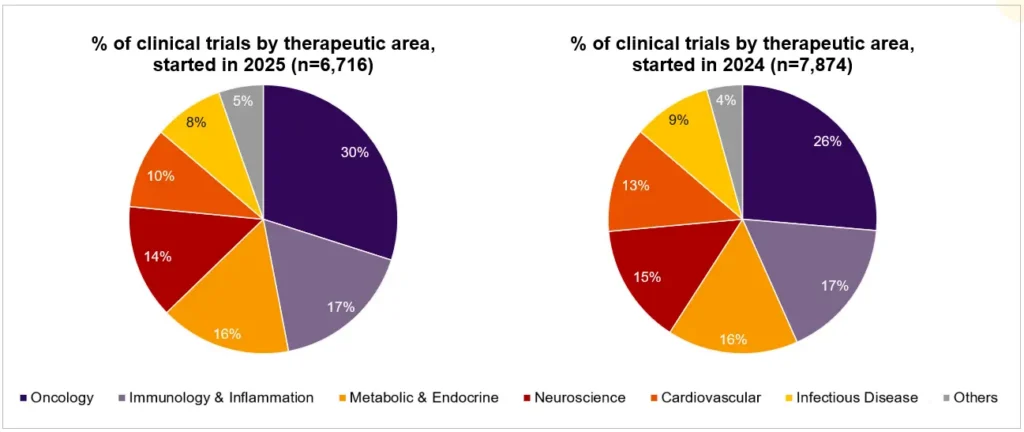
Pie Chart 1: Distribution of trial activity/volume by key therapeutic areas, clinical trials 2025 (left), and clinical trials 2024 (right)
Clinical Trial Trends for Key Therapeutic Areas
Clinical trials continue to be primarily focused on a select group of therapeutic areas, both established and emerging. Although the total number of trials has fallen marginally, the distribution among the therapeutic areas is somewhat stable with minor shifts.
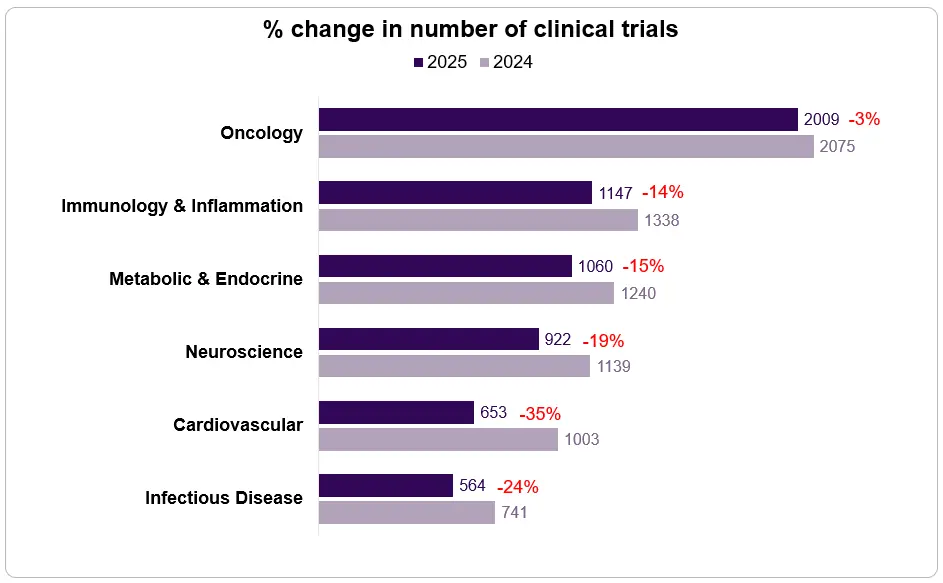
Bar Chart 1: Percentage change in clinical trial count for key therapeutic area (2025 vs. 2024)
Oncology continues to dominate clinical development:
Oncology maintains its long-standing status as the largest therapeutic focus area.
- Trial activity increased to 30% of total trials in 2025 compared to 26% in 2024, despite the overall reduction in the trial count.
- The top focus of current research and development in oncology is on solid tumors.
Neuroscience trials decline marginally:
Central Nervous System (CNS) disorders also remain a consistent focus area for clinical development activity with a negligible decline in the volume for neuroscience trials.
- CNS trials accounted for 15% of total studies in 2024 and about 14% in 2025.
- There is continued investment in therapeutics for these indications, with neurodegenerative diseases (such as Alzheimer’s and Parkinson’s), psychiatric conditions, and neurological conditions (like pain) driving innovation in CNS clinical development.
Infectious disease clinical development stabilizes:
- Infectious disease trials comprised 9% of total clinical studies in 2024 and 8% in 2025. This implies stabilization of research activity in this area following the surge in trials (2020-2023) as a result of the COVID-19 pandemic.
- Key development areas within infectious disease include respiratory infections, bacterial/viral vaccines, and antiviral therapies.
Cardiometabolic trials decrease in share:
- Cardiometabolic trials constitute a strong share of the overall pipeline, however, there was a decrease in percentage of total trials per year from 29% in 2024 to 26% in 2025, largely driven by a reduction in cardiovascular studies, since metabolic and endocrine studies remained stable.
- Obesity and diabetes trials are the major driving factors for growth in cardiometabolic clinical development.
Immunology & Inflammation remains stable:
- Immunology & inflammation clinical development remained relatively stable between 2024 and 2025, comprising 17% of total trials in both years.
- Dermatological autoimmune conditions (like atopic dermatitis and psoriasis), inflammatory bowel diseases (ulcerative colitis and Crohn’s disease), respiratory disease (COPD) and lupus are the top researched indications.
Clinical Trial Trends for Other Categories
Beyond core therapeutic areas, other overlapping segments such as rare disease, cell and gene therapy (CGT) and pediatrics warrant further analysis. These are important areas of innovation and continue to drive investment within the broader clinical trial landscape.
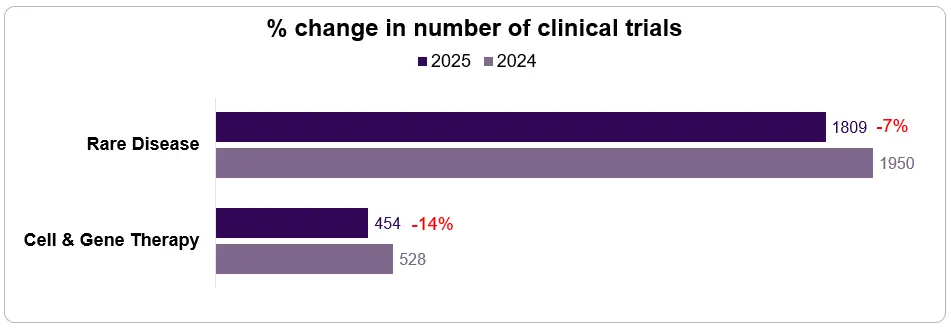
Bar Chart 2: Percentage change in clinical trial count for cross-functional areas (2025 vs. 2024)
Rare Disease:
Rare disease is an important area for clinical development since these conditions, although individually rare, affect over 300 million people worldwide, drastically impacting their lives.
- Rare disease clinical trials increased in trial volume accounting for 25% of total trials in 2024 and 27% in 2025.
Cell & Gene Therapy:
Cell and gene therapies continue to be incredibly impactful for clinical development.
- Cell and gene therapy (CGT) trials represented 7% of trials in both 2024 and 2025.
- Oncology remains the top therapeutic area for cell and gene therapy clinical trials.
Pediatrics:
Pediatric trials continue to represent an important component of the clinical research landscape.
- Studies involving pediatric populations accounted for 10% of trials in both 2024 and 2025.
Clinical Development – Phase Distribution:
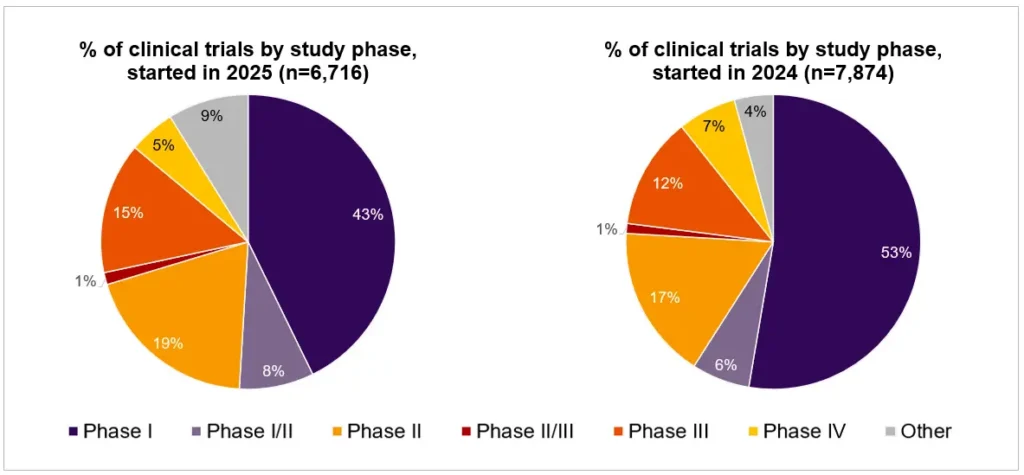
Pie Chart 2: Distribution of trial activity/volume by phases, clinical trials 2025 (left), and clinical trials 2024 (right)
The phase distribution of clinical trials indicates a shift from early-stage innovation toward late-stage studies. In 2025, more programs advanced from Phase I into Phases II and III rather than early-stage studies. Phase I studies fell from 53% of total trials in 2024 to 43% in 2025, while Phases II & III noted an increase from 17% to 19% and 12% to 15%, respectively.
These findings suggest that a growing number of studies are heading toward regulatory approvals and later-stage validation rather than early-stage studies. It can also be a result of changes in capital conditions since early-phase studies are often riskier as an entry point compared to later-phase studies that have already cleared a sizeable portion of safety and regulatory validations, leading sponsors to be more selective about the studies they are initiating.
Clinical Development Outlook
The clinical development landscape is continuously evolving as biopharma industry sponsors prioritize development in these key therapeutic areas. At the same time, areas such as rare diseases, cell and gene therapies, and pediatric research continue to be important in shaping clinical pipelines and driving innovation. As clinical trial trends continue to shape the development pipeline, sponsors must consider several factors such as complexity of trials, regulatory requirements and operational challenges, making the selection of the right CRO partner for this process crucial.
Why is Allucent the best CRO partner for small and mid-size biopharma companies?
Allucent is a global, tech-enabled, specialty CRO headquartered in Cary, NC, helping small and mid-size biopharma companies within targeted therapeutic areas, including complex and rare indications, as well as emerging modalities. We provide full-service clinical development solutions, from early phase to post-approval, with integrated clinical pharmacology, regulatory strategy, and global trial delivery to de-risk development and accelerate key milestones.
Allucent takes a focused, therapeutic-driven approach to the process of clinical development with our Allucent Centers of Expertise (ACEs). Each of these is centered around extensive scientific, regulatory and operational expertise in key therapeutic areas identified based on trends in clinical trials. These include oncology, neuroscience, and infectious disease, along with emerging areas such as cardiometabolic and immunology & inflammation.
Our deep therapeutic expertise is complemented by equally strong capabilities and operations. Patient recruitment and study design are supported by our well-established global site network, while full-service capabilities spanning early phase through pivotal trials help us deliver meaningful studies with integrated clinical pharmacology, regulatory strategy and trial operations. We help sponsors navigate complex development pathways and accelerate key milestones while maintaining study integrity.
As a tech-enabled CRO, we use advanced analytics and AI to boost clinical trial performance. Our proprietary AI solution, LucentAI, allows us to integrate data-driven insights throughout trial design and execution. This helps sponsors make better, timely decisions, minimize uncertainty and complications, as well as utilize resources effectively. By incorporating technology directly into clinical workflows, we boost efficiency, speed up timelines, and improve the chances of success in a complex study environment.
The intentional alignment of our developmental structure with evolving clinical trial trends sets us apart as the best CRO partner for small and mid-size biopharma companies. Allucent works closely with sponsors to bring new therapies to light.
Contact us to learn how we can support your clinical development program.
Source: Citeline Trialtrove; data as of June 2026. Includes industry-sponsored global trials (ongoing and completed).
FAQs
Request a Proposal
Share This