
Drug‑induced QT prolongation and torsades de pointes (TdP) remain critical safety concerns in drug development, driving regulators to refine guidance over the past two decades. Since 2005, ICH E14 has required a robust assessment of QTc prolongation risk, but the field has shifted from a one‑size‑fits‑all thorough QT (TQT) study toward more flexible, efficient pathways that leverage early clinical pharmacology data and integrated nonclinical evidence.
This evolution reflects two key needs: reducing unnecessary stand‑alone TQT studies and preventing early termination of promising compounds based solely on an isolated QT “signal”, or a positive in vitro Ether-à-go-go-related gene (hERG) finding, when overall proarrhythmic risk is low. Updated ICH E14/S7B Q&A documents (2015, 2018, 2022) now clearly describe how concentration‑QTc (C‑QTc) modeling and high‑quality nonclinical packages can substitute for or replace traditional TQT designs in many programs.
The Shift Away from Traditional TQT to C‑QTc
The original TQT paradigm was built around a dedicated, placebo‑ and positive‑controlled study designed to exclude a mean QTc effect above 10 ms at all timepoints, typically using moxifloxacin as the positive control to demonstrate assay sensitivity. While effective scientifically, this format is expensive, resource‑intensive, and logistically complex. These characteristics are especially problematic when the study is performed late in development or when supratherapeutic exposures are difficult to achieve.
C‑QTc modeling using paired pharmacokinetic (PK) and ECG data across multiple dose levels and timepoints has now emerged as the primary decision framework for classifying proarrhythmic risk. Compared with traditional intersection–union testing by time and dose, C‑QTc analyses can substantially reduce sample size; TQT studies using C‑QTc as the primary analysis have shown median reductions in sample size in the range of roughly one‑third to two‑thirds, depending on design, while preserving power.
Three QTc Assessment Pathways
The FDA Interdisciplinary Review Team (IRT) for cardiac safety recognizes three main QTc assessment pathways that sponsors can use to satisfy ICH E14 requirements:
- Thorough QTc study (traditional ICH E14 design)
- Substitute for a thorough QTc study (ICH E14 Q&A 5.1)
- Alternative QTc study when a TQT is not feasible (ICH E14 Q&A 6.1)
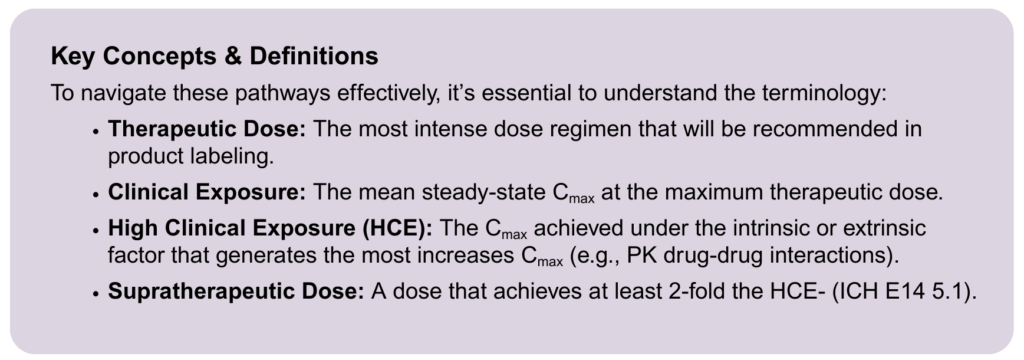
Early cross‑functional planning around these definitions allows clinical pharmacology, nonclinical safety, and modeling teams to build aligned designs that satisfy regulators while avoiding unnecessary additional trials.
The three pathways can be summarized along a few practical dimensions relevant to study design and regulatory expectations.
| Feature | Traditional TQT | Substitute TQT (ICH E14 5.1) | Alternative QTc (ICH E14 6.1) |
| Typical population | Healthy participants | Healthy participants (SAD/MAD) | Patients |
| Control design | Placebo + positive control | Placebo; no positive control | Usually, no placebo; no positive control |
| Required exposure level | Covers HCE | ≥ 2-fold HCE | ≥ Therapeutic; may not reach 2-fold HCE |
| Primary analysis | By time point analysis or C-QTc modeling | C-QTc modeling | C-QTc modeling |
| Nonclinical support1, 2 | None beyond standard ICH S7B | Required if 2-fold HCE is not reached | Required and includes in vivo assay with similar sensitivity to TQT study |
1 hERG assays following best practices; 2 in vivo (non-rodent) assay exposures covering high clinical exposures of parent and major human metabolites
C-QT = Concentration-QT; HCE = high clinical exposure; MAD = multiple ascending dose; SAD = single ascending dose; TQT = thorough QT
Adopted from Ji,Y. et al, J Pharmacokinet Pharmacodyn 52, 37 (2025)
TQT with C‑QTc as Primary Analysis
C‑QTc as the primary analysis has become standard practice when a TQT study is performed. This approach evaluates the exposure–response relationship for QTc using all available matched PK - ECG, rather than testing each timepoint in isolation, which improves efficiency and interpretability and reduces the number of subjects needed to achieve power. With appropriate design and data quality, a negative C‑QTc analysis, defined by one-sided upper bound (UB) of 90% confidence interval (CI) for the predicted placebo‑corrected change in QTc (ΔΔQTc) remaining below 10 ms across the range of clinical and supratherapeutic exposures that covers the high clinical exposure (≥ HCE), is sufficient to rule out clinically relevant proarrhythmic risk.
ICH E14 Q&A 5.1: Substitute for TQT Study
The ICH E14 5.1 pathway allows most investigational products to use early‑phase studies such as single‑ascending dose (SAD) and multiple‑ascending dose (MAD) trials as a substitute for a separate TQT, provided certain conditions are met. The central objective is to obtain high‑quality PK–ECG data at exposures that clearly exceed HCE, enabling a robust C‑QTc assessment without the operational burden of a full TQT.
Key design features for ICH E14 5.1 pathway include:
- Achieving at least 2-fold HCE
- High‑quality ECG collection for active and placebo participants (triplicate 12‑lead ECGs, standardized posture, time‑matched PK sampling, and use of a core ECG lab)
- Adequate concentration range and sampling with time-matched ECGs for active and placebo participants to characterize the C-QTc relationship
If exposures (i.e., Cmax) do not reach the target 2‑fold HCE, integrated nonclinical data – hERG and in vivo “double‑negative” (ICH E14 S7B Q&A 2022) findings – are ordinally essential to support a negative QT conclusion. When these criteria are satisfied and UB of 90%CI of ΔΔ QTc results from C‑QTc remains below 10 ms threshold at relevant exposures, C-QT analysis can substitute for a TQT study even though data from a positive control are lacking.
ICH E14 Q&A 6.1: Alternative QTc Study When TQT Study Is Not Feasible
Some drugs simply cannot be studied in healthy volunteers, including many oncology agents, drugs that markedly alter heart rate, or products whose safety profiles preclude supratherapeutic dosing. For these compounds, the ICH E14 6.1 alternative pathway provides a structured way to assess QTc risk using a “totality of evidence” approach centered on patient data.
Under ICH E14 6.1, QTc assessment generally relies on:
- Carefully collected QTc data in patients at therapeutic doses (often without placebo or positive control)
- Adequate concentrations and PK sampling with matched ECGs to characterize the C-QT relationship
- An integrated nonclinical assessment, including robust in vitro hERG margins and well‑designed in vivo QT studies that follow ICH S7B best practices
To support low likelihood of proarrhythmic effect, cardiac safety database across studies suggests no increase of adverse events that signal potential proarrhythmic effects, UB of 90% CI of baseline-adjusted QTc (ΔQTc) below 10 ms computed from C-QT analysis, and “double-negative” integrated nonclinical data. Because patient‑based data are often noisier and less controlled than healthy participants’ data, nonclinical in vivo studies require a higher level of study sensitivity for ICH E14 6.1 to ensure residual risk is acceptable. Sponsors should anticipate close regulatory scrutiny of exposure coverage, confounding factors, and ECG methodology when pursuing this pathway.
Nonclinical “Double‑Negative” Concept
The 2022 ICH E14/S7B Q&A update highlights the role of integrated nonclinical risk assessment in both ICH E14 5.1 and ICH E14 6.1, introducing the idea of a “double‑negative” integrated nonclinical assessment. In practice, this means demonstrating:
- hERG assays following best practices (ICH S7B Q&A 2.1) showing low risk for parent and metabolite (ICH S7B Q&A 1.1)
- No evidence of QTc prolongation in an in vivo assay conducted according to ICH S7B Q&A 3 at exposures covering HCE of parent and major human metabolites
- ICH E14 6.1 in vivo requires a study to have sufficient power to detect a QTc prolongation similar to a dedicated clinical QT study
A well‑executed double‑negative package can offset the limitation in exposure for ICH E14 5.1 and the limitation in control for ICH E14 6.1 pathways.
Choosing the Right Pathway
Selecting the appropriate QTc pathway is an exercise in structured decision‑making that should begin early in development. The high‑level logic can be summarized as: if the drug can be safely dosed in healthy participants with exposure reaching at least 2-fold HCE, ICH E14 5.1 substitute design using SAD/MAD data is usually preferred; if not, and only patient data are feasible, ICH E14 6.1 alternative pathway is more appropriate. Otherwise, prior to performing patient studies, a TQT study with a C-QTc primary endpoint is appropriate.
Early scenario planning helps clarify whether to invest in supratherapeutic dosing in healthy participants, how to design nonclinical studies to meet current S7B expectations, and how to embed robust C‑QTc modeling into first‑in‑human and subsequent trials. Engaging quantitative, clinical pharmacology, and nonclinical teams at protocol design stage often prevents later redesigns and accelerates regulatory interactions.
Ultimately, QTc strategy selection is no longer a binary choice between TQT and alternative designs, but a structured evaluation of exposure margins, clinical feasibility, and integrated nonclinical evidence early enough to guide development decisions.
FAQs
Request a Proposal
Share This