
Click below to download the infographic.
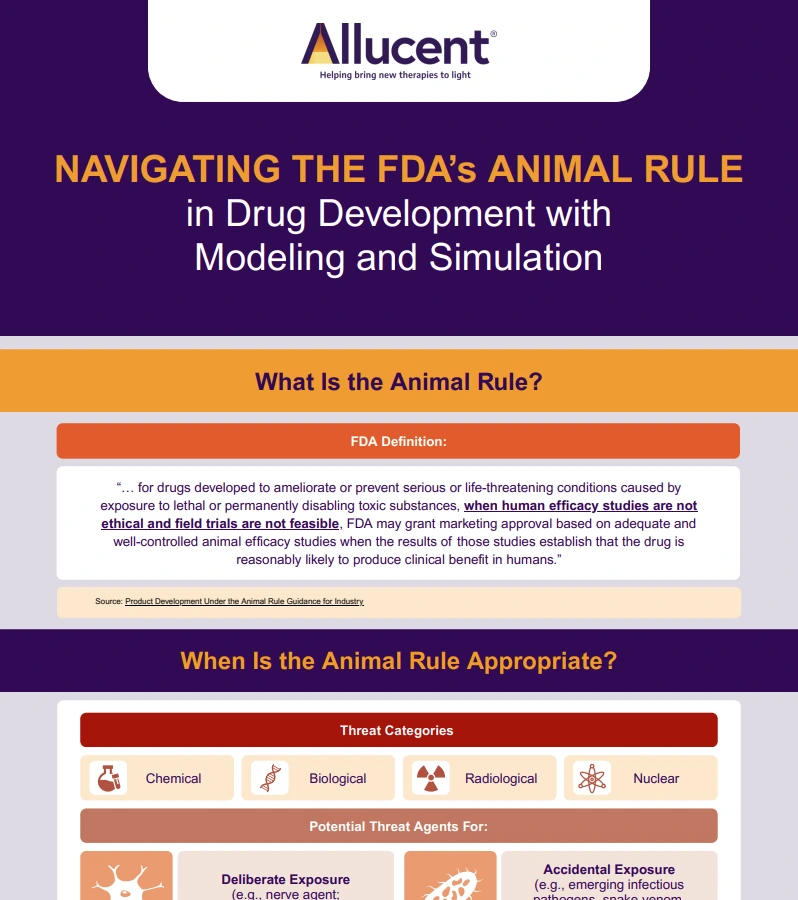
Developing therapies for serious or life-threatening conditions where human efficacy trials are not ethical or feasible presents a unique set of regulatory and scientific challenges. Under the FDA’s Animal Rule, sponsors must rely on well-controlled animal studies to demonstrate efficacy, requiring a clear understanding of disease pathophysiology and established endpoints that translate meaningfully to human outcomes.
To support this translation, modeling and simulation play a critical role in bridging animal efficacy data with human safety and exposure profiles. By integrating pharmacokinetics, exposure-response relationships, and cross-species scaling approaches, these methods enable more informed dose selection and help reduce uncertainty in the absence of traditional clinical efficacy data.
This infographic explores:
- The core regulatory criteria required under the FDA’s Animal Rule
- Best practices for species selection and survival-based endpoints
- Approaches to integrating pharmacokinetics and exposure-response relationships
- The growing role of modeling and simulation in translating preclinical findings to human outcomes
For more information on leveraging modeling and simulation to successfully navigate the FDA’s Animal Rule, watch the recording of our webinar, Navigating the FDA’s Animal Rule in Drug Development with Modeling & Simulation.
Request a Proposal
Share This