
Oncology remains one of the most active and innovative areas of biopharma research and accounts for the largest share of global clinical development activity. Advances in cancer biology, biomarker-driven patient selection, precision oncology, and novel therapeutic modalities have changed the landscape over the past few years, presenting new opportunities to tackle previously difficult-to-treat malignancies.
Both the concentration of clinical trials and funding activity reflect similar oncology trends. About 30% of the funding raised in 2025 (exclusively for drug development and clinical trial activities) was directed to oncology. This is very much in line with its share of total clinical trial activity, with oncology comprising about 30% of all ongoing and completed trials conducted in the year. It highlights the sector’s continued importance in the wider biopharma development landscape.
Analysis of ongoing and completed oncology clinical trials demonstrates this continued evolution of the field. Overall oncology trial activity was relatively stable from 2024 to 2025, but there were shifts in the development phases and in the emerging treatment modalities such as antibody-drug conjugates (ADCs), bispecifics, cell & gene therapies, and radiopharmaceuticals.
Oncology Remains the Largest Area of Clinical Development
The total number of oncology trials (ongoing and completed) decreased by approximately 3% in 2025 compared to 2024. This may be the result of broader challenges faced in clinical development, such as funding constraints, regulatory complexity and portfolio prioritization. Clinical trials in all other therapeutic areas put together have declined by approximately 20%, indicating that even in an unfavorable market, oncology remains a leading area of focus for both emerging and established biopharma companies.
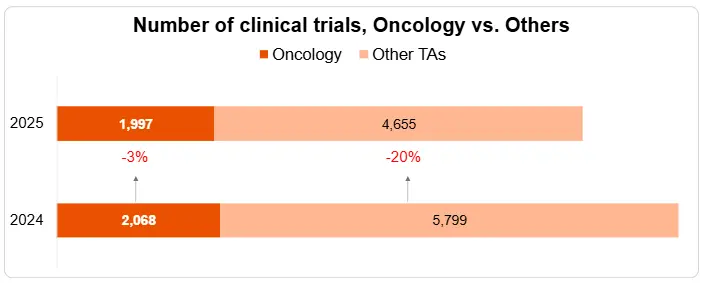
Figure 1: Clinical Trial Count and Year-Over-Year (%) Change for Oncology vs. All Other Therapeutic Areas Combined (2025 vs. 2024)
Leading Indications in Oncology
Although overall oncology clinical trial activity was relatively stable between 2024 and 2025, a number of notable shifts were observed across individual cancer indications. The largest increase in activity was noted for unspecified solid tumors and neuroendocrine cancer. Conversely, the number of studies in breast cancer and non-small cell lung cancer has decreased. These findings could indicate a gradual diversification of oncology development efforts away from some of the traditionally dominant indications, considering the relatively modest change in the overall volume of oncology trials. Substantial activity in existing cancer types is accompanied by growing interest in expanding therapeutic opportunities in a broader range of oncology populations, as exemplified by the ongoing growth in areas such as neuroendocrine tumors, renal cancer and colorectal cancer.
Oncology Clinical Development – Phase Distribution
The distribution of oncology clinical trials across development phases was similar overall in 2024 and 2025. Trials in Phase I, Phase I/II and Phase II together comprised over 80% of all oncology clinical trials in both years, confirming that early-stage studies were the dominant feature of the oncology landscape. The greatest share of activity was for Phase I studies, although this proportion fell slightly from 42% in 2024 to 38% in 2025. Phase II trials remained more or less stable, while the proportion of Phase I/II studies increased from 15% to 18%. Taken together, these findings suggest that early-stage clinical development is still the core focus of oncology research and the main driver of future pipeline growth.
The overall phase distribution changed only modestly, but the year-over-year trial counts show some movement within the development pipeline. The increase in the number of Phase I/II and Phase II/III studies and the slight decline in the number of Phase I and Phase II studies indicate that certain oncology programs may be moving through development rather than remaining concentrated in one phase. It is noteworthy that percentages of Phase III and Phase IV studies remained unchanged, indicating a relatively stable environment for late-stage development. The data suggest a redistribution of activity across phases rather than a major contraction or expansion of the oncology pipeline, with total oncology trial activity down only 3% over the same period.
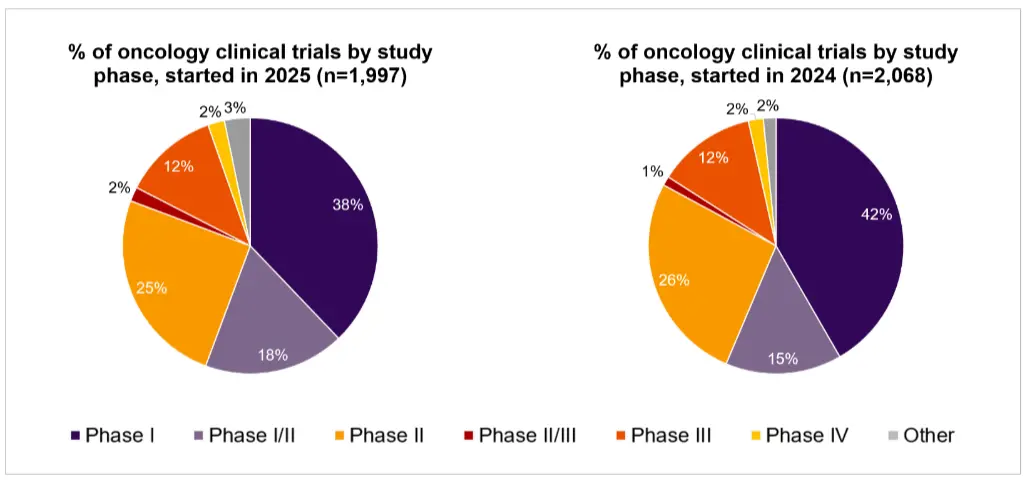
Figure 2: Distribution of Trial Activity by Phase Volume, Oncology Clinical Trials 2025 (Left), and Oncology Clinical Trials 2024 (Right)
The year-over-year changes in trial counts provide further insight as to how oncology programs are moving through development. The Phase I trials decreased by 12% between 2024 and 2025 and Phase II trials decreased by 9%. On the other hand, Phase I/II studies grew by 17%, and Phase II/III studies grew by 50%. Activity in later stages remained steady, with phase III trials declining by 6% while phase IV studies increased by 8%. Overall oncology trial activity declined by only 3% over the same period, while increases seen in Phase I/II and Phase II/III studies are consistent with programs continuing to progress through development. Although the number of trials alone cannot definitively establish the progression of individual candidates from one phase to the next, the overall distribution is consistent with a pipeline that is active over the entire oncology clinical development cycle and continues to mature to later-stage evaluation.
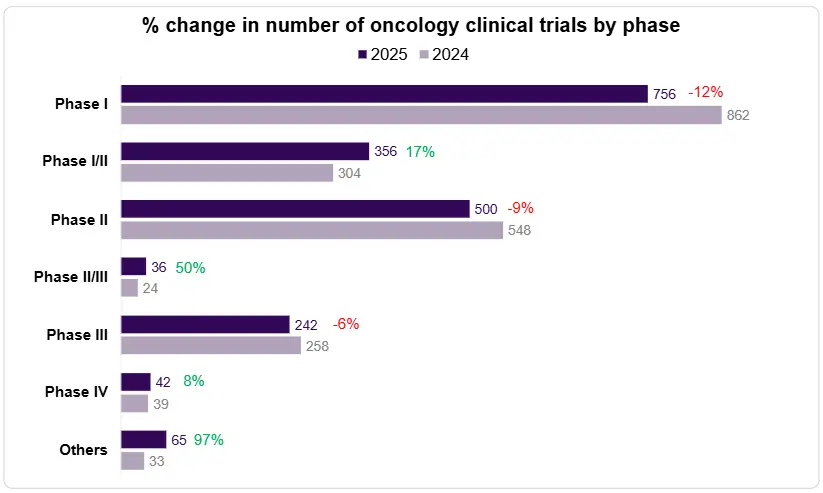
Figure 3: Distribution of Oncology Clinical Trial Activity by Phases and Year-Over-Year (%) Change (2025 vs. 2024)
Oncology Trends: Clinical Development Across Drug Classes and Disease Rarity
In addition to overall trial activity and phase distribution, several specialized areas continue to influence the direction of oncology clinical development. Key drug classes such as antibody-drug conjugates (ADCs), bispecifics, and cell and gene therapies (CGTs) are expanding the treatment landscape across multiple cancer types, while clinical research in rare oncology continues to address significant unmet medical need. Looking at trends in oncology provides further insight into where innovation, investment, and clinical activity are increasingly concentrated.
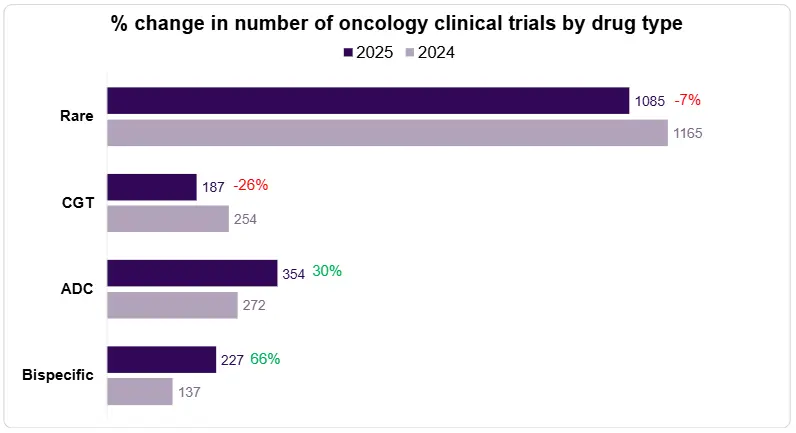
Figure 4: Distribution of Oncology Clinical Trial Activity by Drug Type and Disease Rarity and Year-Over-Year (%) Change (2025 vs. 2024)
Antibody-Drug Conjugates Continue Their Rapid Expansion
Antibody-drug conjugates (ADCs) represent one of the fastest-growing drug classes in the oncology pipeline. From 2024 to 2025, the number of studies using ADC candidates increased by 30% despite the slight overall decline in oncology trials. This is indicative of growing confidence in the ADC platform, advances in linker technology and increasing interest in combination approaches with immunotherapies and targeted agents, all of which are reflected in a growing number of ADC programs. Developers are also looking at new modalities, dual-targeting approaches and indications outside the traditionally targeted tumor types.
Bispecific Antibodies Emerge as a Major Growth Area
Amongst the drug types featured for the 2024-2025 period, the fastest-growing area within oncology is bispecific antibodies. The number of oncology trials focusing on bispecific antibodies climbed by a staggering 66% in 2025. The segment’s strong growth likely reflects increasing clinical validation, a growing number of regulatory approvals, and continued investment from big pharma and biotech innovators. This is now one of the most closely watched areas within oncology research, with multiple bispecific platforms being evaluated in both hematologic malignancies and solid tumors.
Cell and Gene Therapy Activity Declines
During 2024-2025, the number of oncology clinical trials that focused on cell and gene therapy candidates decreased by 26%. This trend is likely indicative of a wider industry emphasis on identifying programs with maximum clinical and commercial potential. The complex manufacturing requirements, high development costs, and operational challenges associated with cell and gene therapies may have contributed to the increased selectivity observed within the sector.
Rare Oncology Remains an Area of Significant Need
Rare oncology indications continue to represent a sizeable proportion of the oncology clinical trial landscape. Although the number of rare oncology trials decreased by approximately 7%, these indications still accounted for more than half of all oncology clinical trial activity during the analysis period. This highlights the continued importance of rare cancers as an area of focus for oncology clinical development. Rare cancers often face challenges related to diagnosis, patient recruitment, and limited treatment options, making clinical research particularly important for advancing new therapeutic options and addressing unmet patient needs.
Emerging Modalities: Radiopharmaceuticals and Precision Oncology
Beyond ADCs, bispecific antibodies, and cell therapies, several emerging modalities are reshaping the oncology development landscape.
Radiopharmaceutical therapies, like radionuclide conjugates, have gained significant attention following recent clinical and commercial successes in prostate cancer and other solid tumors. These therapies combine targeted delivery mechanisms with radioactive payloads, enabling localized tumor destruction while limiting exposure to healthy tissues. Increasing investment and partnership activity suggest continued growth in this area over the coming years.
Precision oncology also continues to influence trial design and development strategies. Biomarker-guided enrollment, genomic profiling, and tumor-agnostic treatment approaches are becoming increasingly integrated into oncology clinical development programs. These strategies enable more personalized treatment selection and may improve both clinical outcomes and development efficiency.
Current Trends in Oncology and Clinical Development Outlook
Although overall oncology trial activity experienced a modest decline between 2024 and 2025, the data indicate that innovation within the field remains strong. Growth in ADCs, bispecific antibodies, and early-stage development programs demonstrates continued investment in novel therapeutic approaches, while ongoing research in rare cancers, pediatric oncology, cell and gene therapies, and radiopharmaceuticals highlights the breadth of innovation occurring across the oncology ecosystem. These findings reflect broader oncology trends shaping the future of cancer drug development.
As scientific understanding of cancer biology continues to advance and new treatment modalities mature, oncology is expected to remain one of the most active and strategically important areas of clinical development worldwide.
Why Choose Allucent as Your Oncology CRO?
With increasing complexity in oncology pipelines, choosing the right oncology CRO has never been more important. Today’s oncology trials demand a combination of scientific expertise, regulatory knowledge, and operational excellence across diverse therapeutic modalities, including antibody-drug conjugates (ADCs), bispecific antibodies, cell & gene therapies, and radiopharmaceuticals, as well as experience supporting rare cancers and biomarker-driven precision oncology programs. By staying at the forefront of emerging oncology trends, our dedicated team is uniquely qualified to help small and mid-size biopharma companies developing novel therapies across a range of oncology indications.
Allucent is an oncology CRO providing comprehensive development support from preclinical planning and IND-enabling activities through late-stage clinical trials, regulatory submissions, and post-marketing studies. Our team has significant experience with adaptive study designs, basket trials, biomarker-driven protocols, patient recruitment strategies and the complex operational requirements associated with modern oncology research. We also support a broad range of therapeutic approaches including targeted therapies, immunotherapies, radiotherapies, and cell & gene therapies, to enable sponsors to confidently navigate increasingly complex development programs.
Allucent leverages deep therapeutic expertise and global operational capabilities to assist sponsors in overcoming recruitment challenges, optimizing study execution, and accelerating development timelines in oncology, the largest therapeutic area we support. Whether supporting first-in-human studies, rare cancer programs, or late-stage registration trials, our oncology CRO experts work alongside sponsor teams to support their efforts in bringing innovative cancer treatments to patients faster. As oncology trends continue to evolve and shape drug development activity, connect with our team of experts who understand the nuances of this process, to see how we can help bring your next therapy to light.
Source: Citeline Trialtrove; data as of June 2026. Includes industry-sponsored global oncology trials (trial status – ongoing and completed).
FAQs
Request a Proposal
Share This