
The evolution of neuroscience clinical trials is driven by advancements in our understanding of disease biology, new therapeutic modalities, and more sophisticated techniques to measure treatment responses. However, challenges like patient heterogeneity, complex endpoints, placebo responses and long development timelines are still to be considered for researchers developing more targeted treatments for all neuropsychiatric illnesses.
The neuroscience clinical trial landscape is a significant source of insight into how these priorities are shifting. Looking at data from 2024, till 2026 YTD, offers a current view of where neuroscience clinical development is focused, and how activity is transitioning across study phases, patient populations and emerging drug modalities. This analysis examines these shifts and identifies key neuroscience trends that will affect clinical development through 2026.
Neuroscience Clinical Trial Activity: 2024-2025
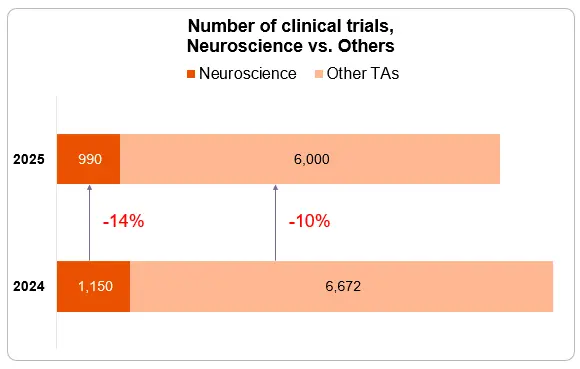
Overall neuroscience clinical trial activity decreased 14% from 1,150 trials in 2024 to 990 in 2025, compared to an 11% drop in overall clinical trial activity, and a 10% drop in the other areas (except neuroscience) combined. However, neuroscience represented a nearly steady percentage of total clinical trial activity in 2025, down to 14.2% from 14.7%. This contraction provides a critical benchmark for analyzing the more recent neuroscience developments seen through H1 2026.
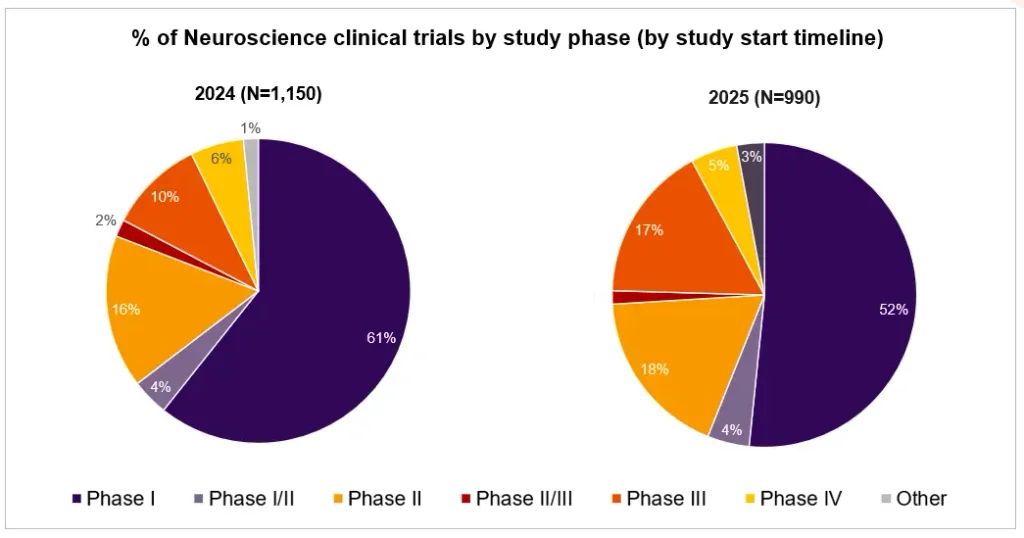
The overall volume change was also accompanied by a shift in the distribution of neurological studies across development periods. In both years, Phase I was the largest category, but its share declined from 61% in 2024 to 52% in 2025. At the same period, the proportion of Phase III trials climbed from 10% to 17%, and Phase II trials went from 16% to 18%. Together, these developments suggest a larger share of activity in mid- and late-stage development in 2025. The phase distribution provides an important lens for understanding wider neuroscience trends and how development activity is being distributed across the pipeline.
Neuroscience Remains an Important Area for Clinical Development: Analyzing the Current Landscape for Neurology & Psychiatry
An analysis of ongoing and completed industry-sponsored clinical trials through H1 2026 provides a current view of how neuroscience activity is changing against the broader clinical trial landscape. The overall trial counts for all other areas dropped 7% from H1 2024 to H1 2025 and fell a further 4% between H1 2025 and H1 2026. While this represents a continued decline in the absolute counts of neuroscience clinical trials, the rate of decline has moderated with a 6% fall in H1 2026 compared to H1 2025 against a much steeper 10% decline between H1 2025 and H1 2024.
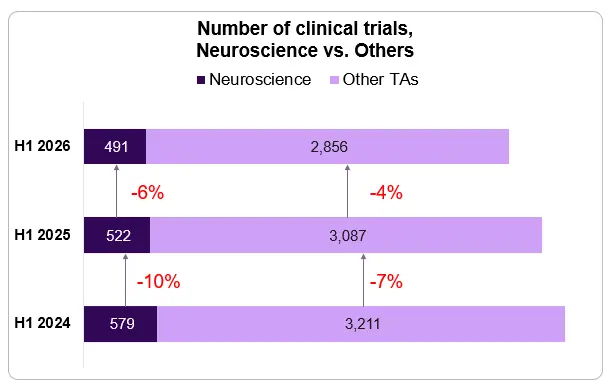
In terms of overall trial volume, however, neuroscience has remained more or less stable, accounting for 15.3% in H1 2024, followed by a small decline to 14.5% in H1 2025 and then again, a slight increase to 14.7% in H1 2026. These numbers provide the basis for understanding broader neuroscience trends across development phases.
Neuroscience Clinical Development – Phase Distribution
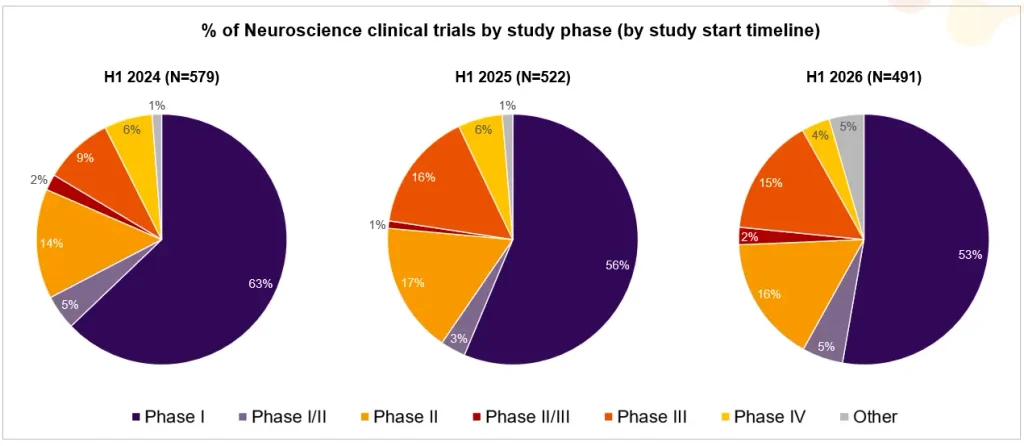
Neuroscience clinical development activity distribution by study phase has varied over the H1 period. The largest component of the pipeline remained Phase I, but its percentage dropped from 63% in H1 2024 to 56% in H1 2025 and 53% in H1 2026. Meanwhile, Phase III grew from 9% to 15% from H1 2024 to H1 2025 and then stabilized at 15% in H1 2026. Phase II was 14% of activity in H1 2024, 17% in H1 2025 and 16% in H1 2026. These changes mean that trends in neuroscience are reflected not only in the total number of trials, but also in how the activity is divided across the development pipeline.
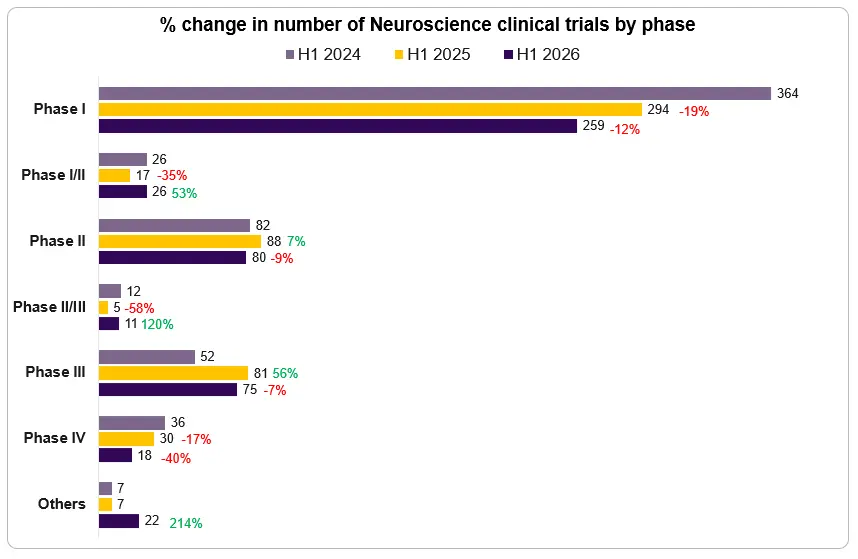
Looking at the absolute change in trial count provides additional context. From H1 2024 to H1 2025, Phase I trials declined by approximately 19%, while Phase III increased by 56%. Phase II decreased by 7%, and Phase I/II declined by 35%. Between H1 2025 and H1 2026, Phase I declined by 12%, while Phase I/II increased by 53% and Phase II/III increased by 120%. Phase III declined by 7%. The overall distribution is consistent with a pipeline that is active over the entire neuroscience clinical development cycle and continues to mature to later-stage evaluation.
Neuroscience Trends: Clinical Development Across Drug Classes and Disease Rarity
The H1 2026 data also show how neuroscience trends are evolving across specialized drug classes and patient populations. While rare disease, cell and gene therapy (CGT), and pediatric trials each represent a relatively small proportion of the overall pipeline, their shares have shifted across the three H1 periods, providing another perspective on where clinical development activity is being concentrated.
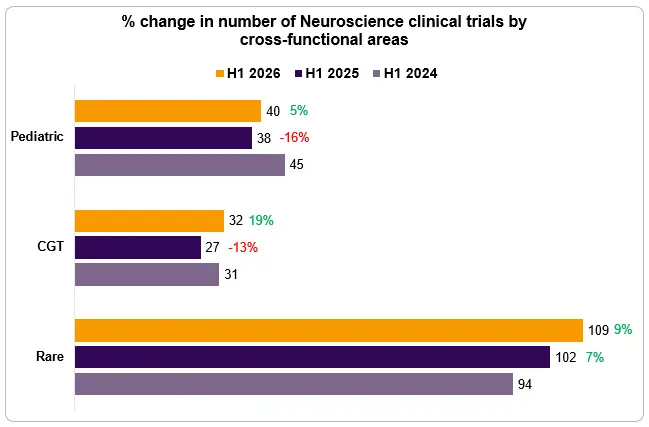
Rare disease trials increased from 18% of total neuroscience activity in H1 2024 to 20% in H1 2025 and 23% in H1 2026. CGT trials followed a similar pattern, rising from 5% to 5% and then 6%, while pediatric trials increased from 7% in H1 2024 to 8% in H1 2025 before moderating slightly to 8% in H1 2026. Although the absolute number of trials in these categories does not necessarily indicate growth in individual programs, the increasing share of activity suggests that specialized populations and advanced therapeutic approaches continue to feature prominently in the evolving neuroscience clinical development landscape.
Rare Disease Trials Continue to Grow
Rare disease activity increased by 7% from H1 2024 to H1 2025, followed by a further 9% increase in H1 2026. This consistent growth highlights rare neurological diseases as an increasingly active area within neuroscience trends, with conditions such as Huntington’s disease, ALS, Friedreich ataxia, and spinal muscular atrophy among the areas where targeted therapeutic approaches continue to be investigated.
Cell Gene Therapy Activity Rebounds in H1 2026
Following a 13% decline between H1 2024 and H1 2025, neuroscience cell and gene therapy (CGT) activity rebounded by 19% in H1 2026. This reversal highlights renewed activity in advanced therapeutic approaches within neuroscience clinical development, particularly for genetically defined neurological diseases where gene-based strategies may target underlying disease mechanisms.
Pediatric Trials Show Early Signs of Recovery
Pediatric neuroscience activity declined by 16% between H1 2024 and H1 2025 before increasing by 5% in H1 2026. This slow return to growth highlights a potential shift in pediatric development activity, much of which overlaps with rare and neuromuscular disease research. Conditions such as spinal muscular atrophy and Duchenne muscular dystrophy frequently require pediatric-specific development strategies, making this an important area to focus on within neuroscience trends.
Emerging Modalities: Psychedelics, Gene Therapies and Novel Mechanism-Based Treatments
The neuroscience trends emerging in 2026 reflect a growing emphasis on treatments designed to address underlying disease mechanisms rather than only managing symptoms. Psychedelic therapies remain one of the most closely watched areas, with continued clinical development of compounds such as psilocybin and DMT for psychiatric disorders. Recent research is also moving beyond efficacy questions toward understanding their effects on brain circuitry and identifying how these therapies can be developed into scalable treatment approaches. At the same time, newer psychedelic-inspired compounds and other novel chemical entities are entering development, potentially offering more conventional dosing and treatment models.
Cell and gene therapies are another important area of innovation, particularly for genetically defined rare neurological and neuromuscular diseases. Advances in gene therapy platforms and next-generation delivery approaches are creating opportunities to target disease biology more directly, while cell therapies are being investigated for conditions including epilepsy and neurodegenerative diseases. The continued progress of these approaches is contributing to broader trends in neuroscience, particularly the shift toward disease modification and precision treatment for populations with limited therapeutic options.
Beyond these advanced therapies, the neuroscience pipeline is also expanding through new mechanism-based drug classes and technologies that enable more precise treatment and monitoring. Orexin receptor agonists represent one example of therapies designed to restore disrupted biological signaling in narcolepsy, while RNA-based and other genetic medicines continue to be explored across CNS diseases. In parallel, digital biomarkers, wearables, and other technologies enabling continuous measurement of neurological function could support more sensitive endpoints in neuroscience clinical trials. Together, these developments point toward a more biologically targeted and patient-centered approach to neuroscience clinical development.
Current Trends in Neuroscience and Clinical Development Outlook
The neuroscience landscape is shifting toward more targeted, biomarker-driven and patient-centric approaches, even as overall trial activity continues to moderate. The H1 2026 data show a continued decline in Phase I activity alongside sustained Phase II and Phase III development, indicating that the clinical development pipeline for neuroscience is maturing toward later-stage trials and more assets are advancing toward approvals, while rare disease trials and advanced therapeutic approaches show steady growth and continued activity. At the same time, emerging modalities such as psychedelics, gene therapies, RNA-based medicines and digital measures are expanding the range of approaches being evaluated across neurological and psychiatric disorders. Together, these shifts highlight key neuroscience trends shaping clinical development in 2026, with greater emphasis on precision, meaningful endpoints and strategies that can address the biological and operational complexities of neuroscience trials.
Why Choose Allucent as Your Neuroscience CRO?
Allucent combines deep therapeutic expertise with global clinical development capabilities to help sponsors navigate the complexities of neuroscience research. With more than 30 years of neuroscience experience and 200+ clinical trials across 40+ indications, Allucent supports studies spanning neurodegenerative, neuromuscular, rare neurological, pain, sleep and psychiatric disorders.
As a specialized neuroscience CRO, Allucent brings expertise in complex trial design, regulatory strategy, patient recruitment, endpoint strategy, brain penetration PK/PD, neuroimaging, CSF analysis, cognitive assessments and digital measures. Its integrated approach helps sponsors address challenges such as patient heterogeneity, subjective endpoints and placebo response while maintaining focus on study quality and timelines.
Whether advancing an early-stage program or managing a complex late-phase study, Allucent provides the therapeutic knowledge, operational capabilities and patient-focused strategies expected from an experienced neuroscience CRO. As neuroscience trends continue to shape clinical development activity, connect with our team of experts who understand the nuances of this process, to see how we can help bring your next neuroscience therapy to light.
Request a Proposal
Share This