Clinical development in immunology & inflammation (I&I) continues to evolve as researchers gain a deeper understanding of immune pathways, disease heterogeneity, and the biological drivers underlying autoimmune and inflammatory conditions. Advances in targeted therapies and increasingly sophisticated approaches to patient selection are creating new opportunities, while complex disease profiles, variable treatment responses, and challenges in defining meaningful endpoints continue to shape clinical development.
Clinical trial activity gives a useful view of how these priorities are translating into development programs. Examining 2024 and 2025 alongside data for H1 2026 reveals changes in trial volume, study phase distribution, and activity across specialized populations and therapeutic approaches. This analysis explores these developments and the key trends in immunology influencing clinical research in 2026.
Immunology & Inflammation Clinical Trial Activity: 2024–2025
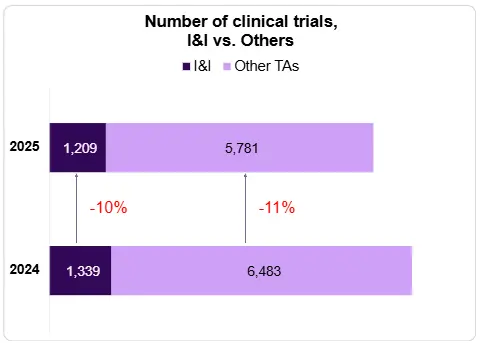
The number of immunology & inflammation clinical trials declined 10%, from 1,300+ in 2024 to 1,200+ in 2025. This was broadly comparable to the 11% decrease across overall clinical trial activity in the other therapeutic areas put together, with I&I accounting for approximately 17% of total trials by volume in both years. The relatively consistent share suggests that the decline in I&I activity is due to the broader contraction in clinical research during this period rather than reduced interest in immunology clinical development.
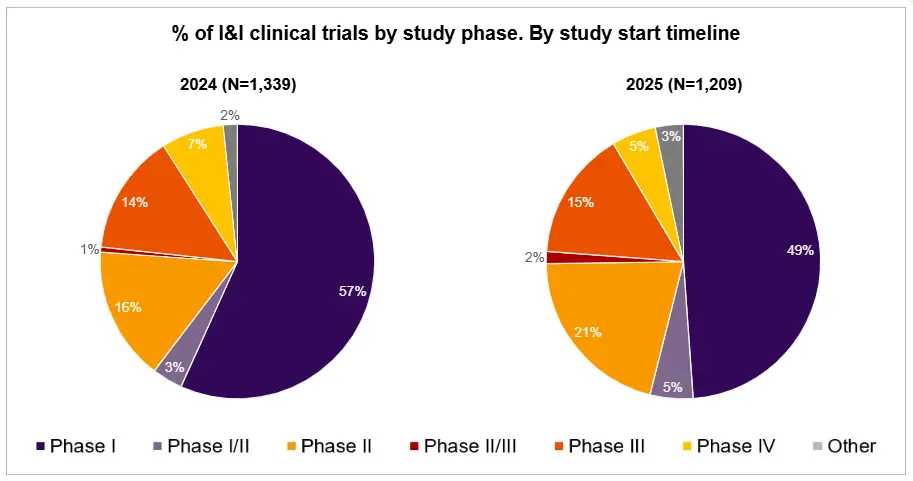
The distribution of I&I trials across study phases also changed between 2024 and 2025. Phase I remained the largest share of activity, although its contribution fell from 57% to 49%. In contrast, Phase II increased from 16% to 21%, while Phase III edged up from 14% to 15%. Phase I/II also increased from 3% to 5%. This shift reflects a greater proportion of I&I activity occurring in mid- and later-stage studies in 2025 compared with the previous year.
Analyzing the Current Trends in Immunology: Through H1 2026
H1 2026 provides a more recent perspective on immunology & inflammation clinical development. I&I trial activity increased by 1% from H1 2024 to H1 2025, before declining 9% in H1 2026. Over the same periods, trial activity across all other therapeutic areas combined decreased by 6% and 4%, respectively. The latest decline therefore represents a change from the relative stability seen in I&I activity during H1 2025.
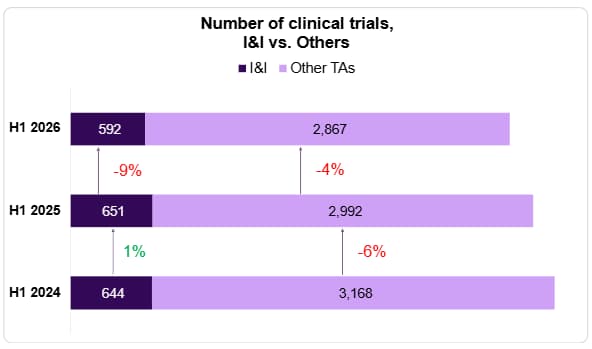
I&I trials represented 17% of overall clinical trial activity in H1 2024, rising to 18% in H1 2025 before returning to 17% in H1 2026. While the proportion has fluctuated slightly, I&I has continued to represent a substantial component of the clinical development landscape. The H1 data also reveals important changes in how this activity is distributed across development phases and specialized therapeutic areas.
Immunology & Inflammation Clinical Development – Phase Distribution
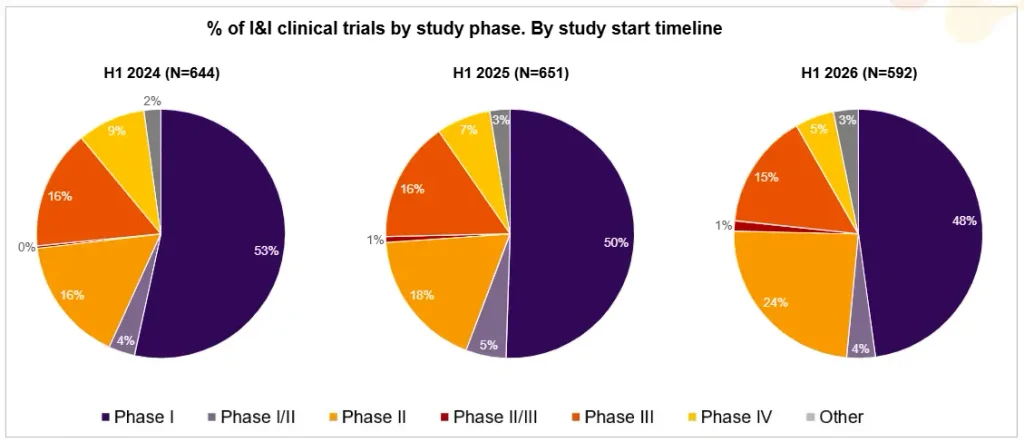
The composition of I&I trial activity shifted noticeably across the H1 periods. Phase I accounted for 53% of trials in H1 2024, declining to 50% in H1 2025 and 48% in H1 2026. At the same time, Phase II grew from 16% to 18% and then 24% across the three periods. Phase III represented approximately 16% of activity in H1 2024 and H1 2025 before declining to 15% in H1 2026. Overall, the distribution points to increasing representation of Phase II studies within the I&I pipeline, possibly as early-stage programs (Phase Is and FIH trials) mature into later stage trials.
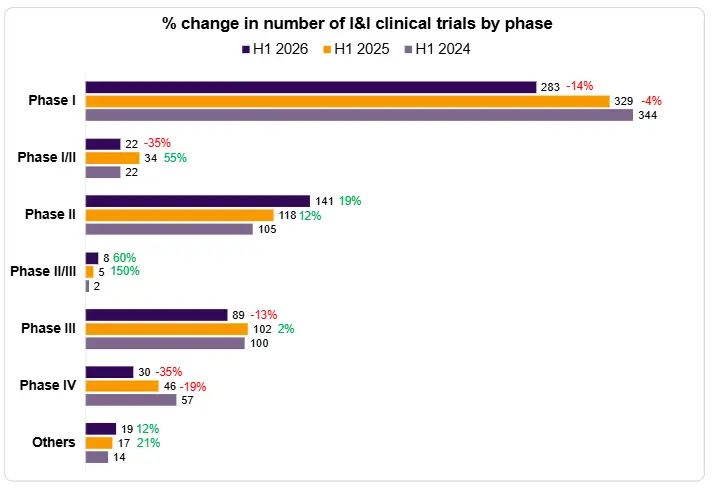
Changes in the number of trials by phase provide further detail. Between H1 2024 and H1 2025, Phase I declined 4%, while Phase I/II and Phase II, and Phase III increased 55% and 12%, and 2%, respectively. Between H1 2025 and H1 2026, Phase I declined a further 14%, while Phase II increased 19%. Phase I/II fell 35%, and Phase III declined 13%.
Trends in Immunology: Clinical Development Across Rare Disease, Cell and Gene Therapy, and Pediatric Trials
The H1 data also highlight contrasting patterns across rare diseases, cell and gene therapy, and pediatric I&I trials. These categories account for smaller portions of overall activity, but their individual trajectories differ across the three periods. Examining these changes provides additional context on how specialized populations and advanced therapeutic approaches are developing within the I&I pipeline.
Rare Disease Trials Stabilize in H1 2026
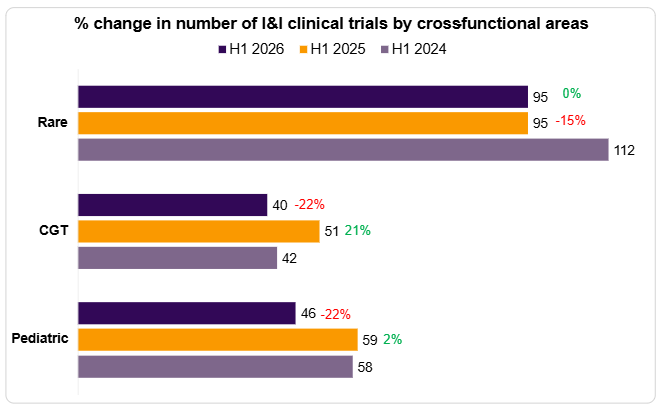
Rare disease trial activity fell 15% from H1 2024 to H1 2025, before remaining unchanged in H1 2026. The stabilization following the earlier decline indicates that activity in rare disease I&I programs was maintained during the latest period, despite the broader reduction in I&I trial volume.
Cell Gene Therapy Activity Contracts in H1 2026
I&I cell gene therapy activity increased 21% between H1 2024 and H1 2025, followed by a 22% decline in H1 2026. The reversal marks a notable change in activity for advanced therapeutic approaches within I&I, following growth during the preceding H1 period.
Pediatric Trials Decline After Modest Growth
Pediatric I&I trials increased by 2% between H1 2024 and H1 2025 before declining 22% in H1 2026. This shift indicates that pediatric development activity has moderated in the latest period, following the slight increase observed in H1 2025.
Emerging Modalities: Targeted Biologics, Cell and Gene Therapies, and Precision Immunology
Recent I&I clinical development reflects continued exploration of new therapeutic targets and treatment formats, alongside established approaches for managing autoimmune and inflammatory diseases. Emerging strategies include novel biologics, oral small molecules, and advanced therapies designed to address unmet treatment needs across these conditions. Advances in monoclonal antibodies and other targeted therapies are enabling more selective modulation of disease-associated mechanisms, while ongoing research is identifying additional biological targets across complex immune-mediated conditions.
Cell and gene therapies are also being explored as potential approaches for diseases where modifying or replacing dysfunctional biological processes could offer an alternative to chronic treatment. CD19-directed CAR T-cell therapies, alongside emerging BCMA-targeted and dual-targeted constructs, are being investigated in refractory autoimmune diseases such as systemic lupus erythematosus, systemic sclerosis, and myositis, with the goal of achieving durable, drug-free remission through immune system reset strategies. Although the H1 2026 data show a decline in I&I CGT activity following growth in H1 2025, the continued presence of these programs reflects ongoing interest in advanced therapeutic strategies within the field.
At the same time, greater understanding of disease heterogeneity is supporting more precision-focused approaches to I&I development. Biomarkers, molecular characterization, and patient stratification can help identify populations more likely to respond to a particular treatment and support more focused clinical trial designs. Together, these developments are broadening the range of strategies available for addressing autoimmune and inflammatory diseases.
Current Trends in Immunology & Inflammation and Clinical Development Outlook
The I&I clinical development landscape is undergoing a period of changing activity across both trial phases and specialized therapeutic areas. H1 2026 saw overall I&I trial volume decline after relative stability in H1 2025, while Phase II activity continued to expand as a proportion of the pipeline. Rare disease activity remained stable, whereas CGT and pediatric trials declined following growth or stability in the preceding period. Alongside these shifts, targeted biologics, advanced therapies, biomarkers, and patient stratification approaches continue to influence how new treatments are being developed.
Overall, I&I trial volume declined between 2024 and 2025, but its share of total clinical trial activity remained relatively steady at around 17%. Through H1 2026, Phase II trials increased in both absolute number and proportion of I&I activity, while specialized segments, including rare disease, CGT, and pediatric trials, followed differing trajectories, with some changes occurring from relatively small trial counts. Alongside these observed patterns, emerging modalities and precision-focused approaches continue to shape the broader I&I development landscape.
Why Choose Allucent as Your Inflammation & Immunology CRO?
Allucent brings specialized therapeutic expertise together with global clinical development capabilities to support sponsors working across complex immunology and inflammation programs. Its experience spans autoimmune and inflammatory diseases across rheumatology, dermatology, gastroenterology, respiratory disease, and other immune-mediated areas, providing insight into the diverse patient populations and clinical considerations involved in I&I research.
As an experienced immunology CRO, Allucent supports sponsors across clinical development with capabilities including trial design, patient recruitment, endpoint strategy, regulatory strategy, medical monitoring, pharmacovigilance, and clinical operations. This integrated expertise helps address challenges associated with complex disease biology, heterogeneous patient populations, specialized eligibility criteria, and variable treatment response.
Allucent also supports cell and gene therapy (CGT) development for autoimmune diseases, helping sponsors navigate patient selection, safety monitoring, and regulatory requirements as they advance innovative therapies targeting underlying immune dysfunction.
From early development through late-phase studies, we combine therapeutic knowledge with operational expertise to help sponsors navigate the complexities of I&I research. Connect with our team to explore how our immunology & inflammation capabilities can support your next clinical development program.
Source: Citeline Trialtrove; data as of September 2026. Includes industry-sponsored global immunology clinical trials (trial status – ongoing and completed).
Request a Proposal
Share This