
Two patients can receive the same administered activity of a radiopharmaceutical and still receive substantially different absorbed doses to their tumors, kidneys, marrow, and salivary glands. Even within one patient, one lesion may receive far more radiation than another.
That distinction is the starting point for radiopharmaceutical development. The activity in the vial, measured in megabecquerels (MBq) or gigabecquerels (GBq), is an input. Absorbed dose, measured in gray (Gy), is the energy deposited per unit mass of tissue. It is closer to the biological exposure that development teams are trying to understand. However, radiation quality, dose rate, microdistribution, and tissue radiosensitivity also influence biological effect.
This creates a development problem that does not fit neatly into the conventional oncology framework. Dose selection, pharmacokinetics, safety monitoring, CMC, imaging, isotope supply, and site operations have to be planned as one connected system.
What Is Radiopharmaceutical Therapy?
Radiopharmaceutical therapy (RPT) uses a radioactive drug or biologic to deliver ionizing radiation to tissue. Some products contain a peptide, small molecule, or antibody that binds a biological target. Others localize through a different mechanism. For example, Radium-223 behaves as a calcium mimetic and localizes to areas of increased bone turnover rather than binding a tumor antigen.
For that reason, terminology matters:
- Radiopharmaceutical therapy is the broad umbrella term used by FDA.
- Radioligand therapy generally refers to an RPT in which a ligand directs a radionuclide-bearing construct to a molecular target.
- Peptide receptor radionuclide therapy is a radioligand approach using a peptide to target a receptor. e.g.; somatostatin receptors.
- Targeted alpha therapy describes treatment with an alpha-emitting radionuclide delivered to a biological target.
- Theranostics pairs diagnostic imaging and therapy directed at the same biological target. The diagnostic and therapeutic products need not be chemically identical.
Why Administered Activity Is Not the Same as Absorbed Dose
Administered activity describes how many nuclear transformations are expected per unit time. It does not show where the radiopharmaceutical distributes, how long it remains in each tissue, or how energy is deposited at organ, lesion, cellular, or subcellular levels.
Same administered activity does not mean the same absorbed dose
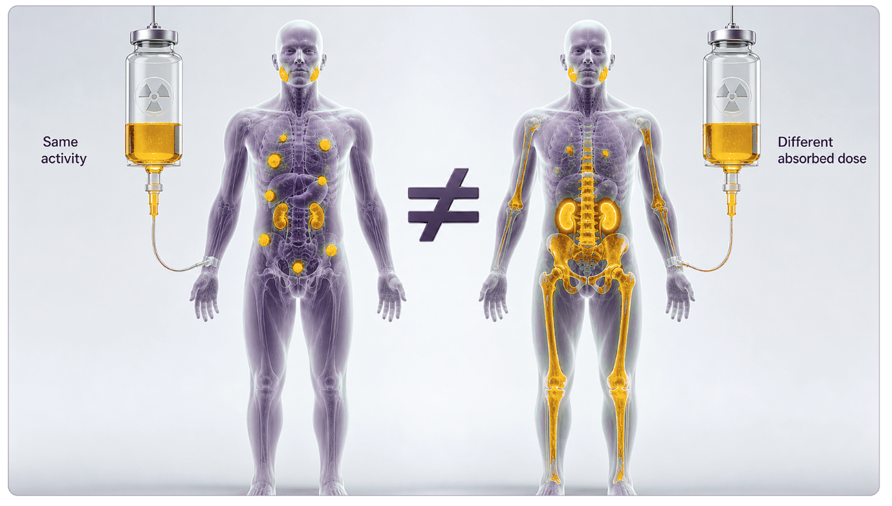
The relationship between activity and biological effect depends on several linked variables:
| Development variable | Radiopharmaceutical implication |
| Administered activity | An input measured in MBq or GBq; not a direct measure of tumor or organ exposure |
| Pharmacokinetics | Must be integrated with radioactive decay, tissue uptake, and residence time |
| Exposure | Better described with tumor and normal-organ absorbed dose than plasma concentration alone |
| Pharmacodynamics | Depends on the spatial and temporal deposition of radiation energy |
| Maximum tolerated dose | May not identify the dosage with the best benefit-risk profile |
| Recommended dosage | Should include activity per administration, interval, number of cycles, and cumulative exposure limits |
The practical consequence is straightforward: two patients receiving the same GBq may not be receiving the same treatment biologically.
Beta and Alpha Emitters Are Different Tools
Beta particles travel farther through tissue and can irradiate cells beyond those that directly bind or internalize the radiopharmaceutical. This crossfire effect can be useful when target expression is heterogeneous. Lutetium-177 has a mean beta-particle range of approximately 0.7mm in soft tissue and also emits photons that support post-therapy imaging.
Alpha particles travel over much shorter distances, typically several cell diameters. However, it deposits energy densely. Radium-223 labeling describes an alpha-particle range of less than 100 micrometers and high linear energy transfer, which increases the likelihood of clustered DNA damage. The short range also makes microscale distribution, intracellular localization, and daughter-nuclide behavior particularly important.
Beta versus alpha radiation: range, crossfire, and ionization density
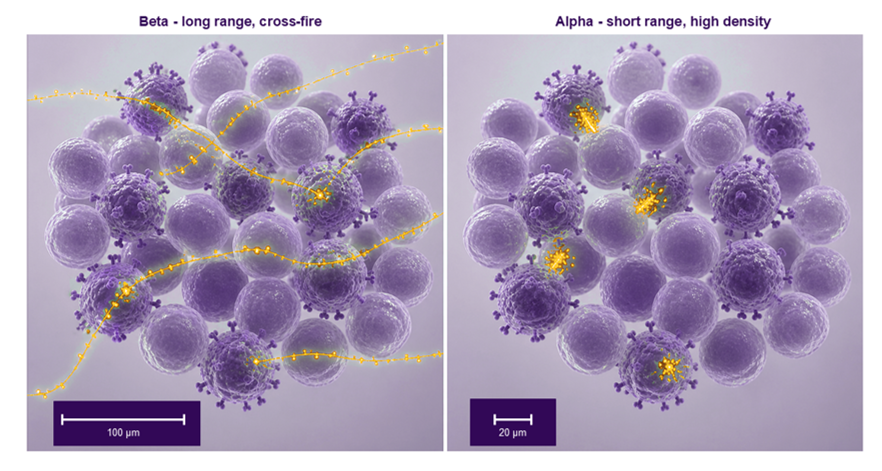
The evidence base must be described at the product level. Lutetium-177 products have randomized Phase 3 evidence and multiple FDA-approved indications. Radium Ra 223 dichloride is an FDA-approved alpha-emitting therapy for castration-resistant prostate cancer with symptomatic bone metastases and no known visceral metastatic disease. By contrast, ligand-directed actinium-225 therapies, including Actinium-225 PSMA-617, remain investigational in the United States. Terbium-161 and lead-212 constructs are also investigational; their safety and effectiveness depend on the complete radiopharmaceutical, not the isotope alone.
Theranostics Adds Spatial Information to Patient Selection
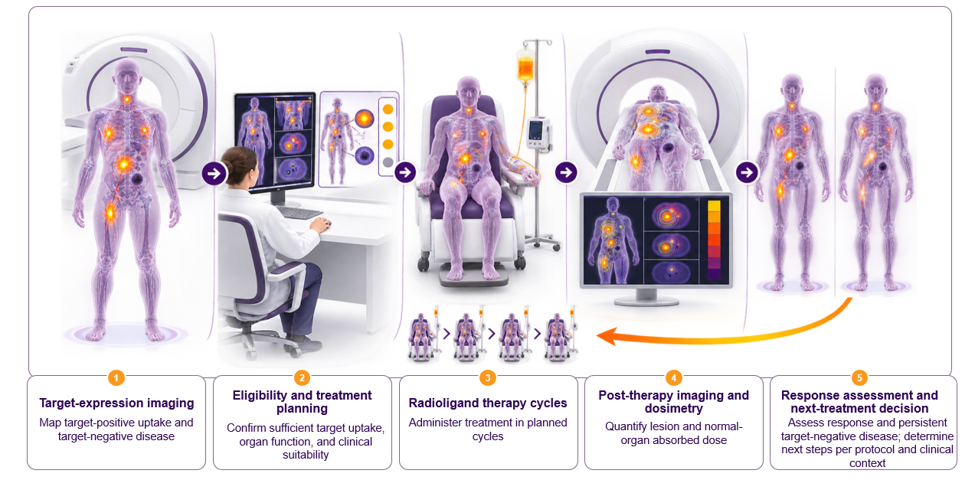
Theranostics links target-expression imaging with treatment directed at the same biological target. Pretreatment imaging can show whether disease is target-positive, how uptake varies between lesions, and whether target-negative disease is present. Post-therapy imaging, when technically feasible, can show where the therapeutic product was distributed and can support dosimetry.
This is more informative than treating a single biopsy as a complete map of metastatic disease. It also introduces new development requirements: eligibility thresholds, scan interpretation rules, reader training, imaging quality control, handling of heterogeneous or discordant disease, and alignment between the diagnostic and therapeutic development plans.
Theranostic treatment pathway: select, treat, quantify delivery, and reassess
Absorbed Dose Emerges From a Coupled System
Absorbed dose is determined by more than isotope selection. The following factors matter:
- Ligand pharmacokinetics and blood-pool clearance
- Target density and accessibility
- Binding, internalization, and intracellular residence
- Tumor retention over time
- Uptake and retention in normal organs
- Radionuclide half-life, emissions, decay chain, and radiation range
- Spatial heterogeneity within and between lesions
Determinants for Absorbed Dose
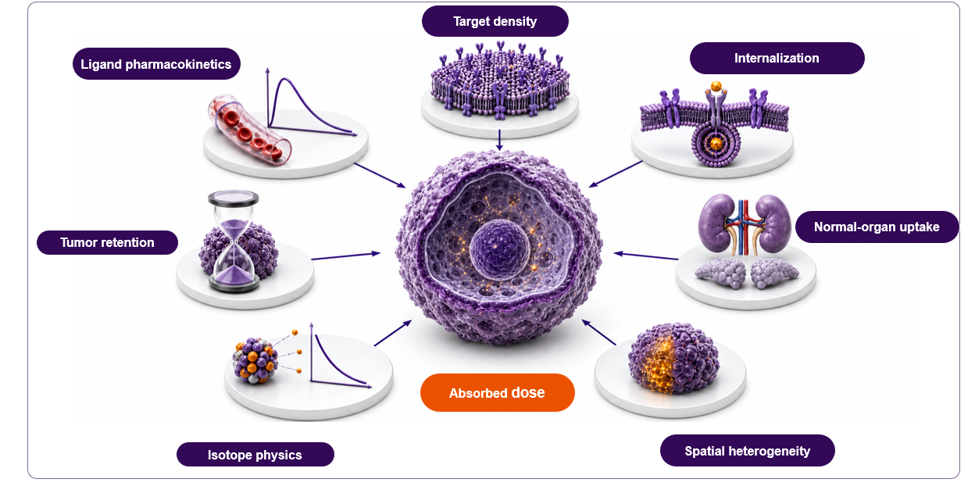
Absorbed dose in Gy is therefore necessary but not always sufficient for cross-product or cross-isotope comparison. Alpha- and beta-emitting products can produce different biological effects at the same macroscopic absorbed dose because their linear energy transfer and microscopic energy deposition differ.
What Current Clinical Evidence Establishes About Radioligand Therapies
Three randomized trials illustrate the expansion of lutetium-177 radioligand therapy into earlier disease settings. They should be interpreted together with the current product labels and their safety information.
NETTER-2
NETTER-2 randomized 226 patients with newly diagnosed, advanced, well-differentiated, somatostatin receptor-positive grade 2 or 3 gastroenteropancreatic neuroendocrine tumors. Lutetium Lu 177 dotatate plus octreotide LAR improved median progression-free survival to 22.8 months, compared with 8.5 months for high-dose octreotide LAR (HR 0.276; 95% CI 0.182–0.418; p < 0.0001). Objective response rates were 43.0% and 9.3%, respectively. Grade 3 or higher adverse events occurred in 35% and 27% of patients. No treatment-related deaths were reported in the primary analysis
In the United States, lutetium Lu 177 dotatate (Lutathera) is approved for adults and pediatric patients aged 12 years and older with somatostatin receptor-positive GEP-NETs, including foregut, midgut, and hindgut tumors.
PSMAfore
PSMAfore compared lutetium Lu 177 vipivotide tetraxetan with a change in androgen receptor pathway inhibitor (ARPI) in 468 patients with PSMA-positive metastatic castration-resistant prostate cancer after progression on one ARPI, when delaying taxane chemotherapy was considered appropriate. In FDA’s analysis, median radiographic progression-free survival was 9.3 versus 5.6 months (HR 0.41; 95% CI 0.29–0.56; p < 0.0001). Overall survival was not statistically different; interpretation was complicated by substantial crossover from the control arm.
On March 28, 2025, FDA expanded the Pluvicto indication to include adults with PSMA-positive metastatic castration-resistant prostate cancer previously treated with an ARPI who are considered appropriate to delay taxane-based chemotherapy. The label also covers patients who have received prior taxane-based chemotherapy.
PSMAddition
PSMAddition randomized 1,144 patients with PSMA-positive metastatic androgen pathway modulation-naïve or -sensitive prostate cancer, previously termed metastatic hormone-sensitive prostate cancer. Adding ¹⁷⁷Lu-PSMA-617 to androgen-deprivation therapy plus an ARPI improved radiographic progression-free survival (HR 0.72; 95% CI 0.58-0.90; p = 0.0021); median radiographic progression-free survival was not reached in either arm. At the reported analysis, overall survival remained immature and was not statistically significant (HR 0.84; 95% CI 0.63-1.13; p = 0.125). Grade 3 or higher adverse events occurred in 286 (51%) of 564 treated patients and 243 (43%) of 565 control patients On July 31, 2026, FDA approved lutetium LU 177 vipivotide tetraxetan in combination with an ARPI for adults with PSMA-positive metastatic androgen pathway modulation-naïve or -sensitive prostate cancer. FDA noted risks including radiation exposure, myelosuppression, renal toxicity, embryo-fetal toxicity, and infertility.
Operational Feasibility Starts With the Decay Clock
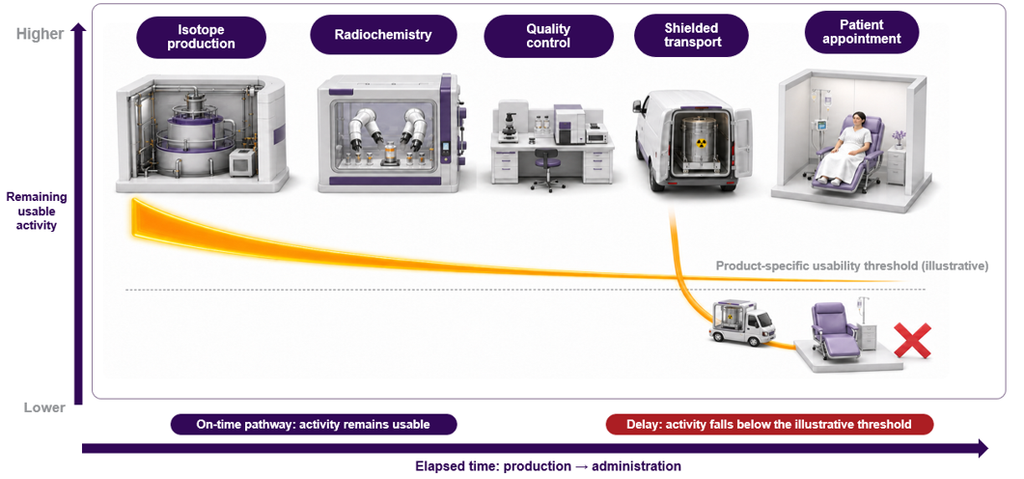
An RPT supply chain links isotope production, radiochemistry, quality control and release, transportation, site receipt, and a scheduled patient administration. Radioactive decay continues throughout that process. A delay can reduce the activity available at administration or make a batch unusable under product specifications and clinical requirements.
Radioactive Supply Chain
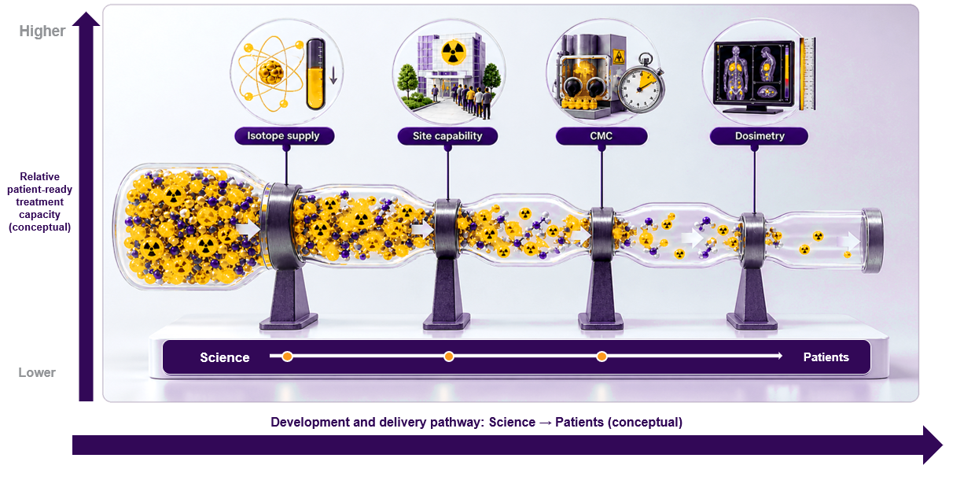
Four Bottlenecks Shape Radiopharmaceutical Development
1. Isotope supply
Supply planning must cover projected demand, production route, radionuclidic purity, impurity profile, transportation, backup supply, and the effect of source changes on comparability.
2. Site capability
An activated oncology site is not automatically ready to administer an RPT. Feasibility should assess the applicable licenses and authorizations, authorized-user and radiation-safety coverage, hot-lab and shielding capacity, PET or SPECT capability, dosimetry resources, nuclear medicine scheduling, radioactive-waste handling, and experience with clinical-trial data requirements. Site discussions should begin while the protocol is still being designed.
3. CMC and release
Manufacturing and release testing operate inside a decay clock. Radionuclidic purity, radiochemical purity, activity concentration, specific or molar activity, sterility assurance, endotoxin control, container-closure integrity, transport validation, and chain of custody must be addressed in a product-specific control strategy. Scale-up can also change impurity profiles, formulation, and effective activity at the time of administration, so clinical and CMC comparability planning should proceed together.
4. Executable dosimetry
A dosimetry plan must work across the intended trial network. Acquisition time points, camera calibration, reconstruction, segmentation, partial-volume correction, time-activity modeling, quality control, data transfer, and central review all affect reproducibility. A scientifically elegant approach that cannot be delivered consistently at participating sites will not support a reliable multicenter decision.
Operational bottlenecks for patient-ready radiopharmaceutical therapy capacity
Fixed Activity or Dosimetry-Guided Activity?
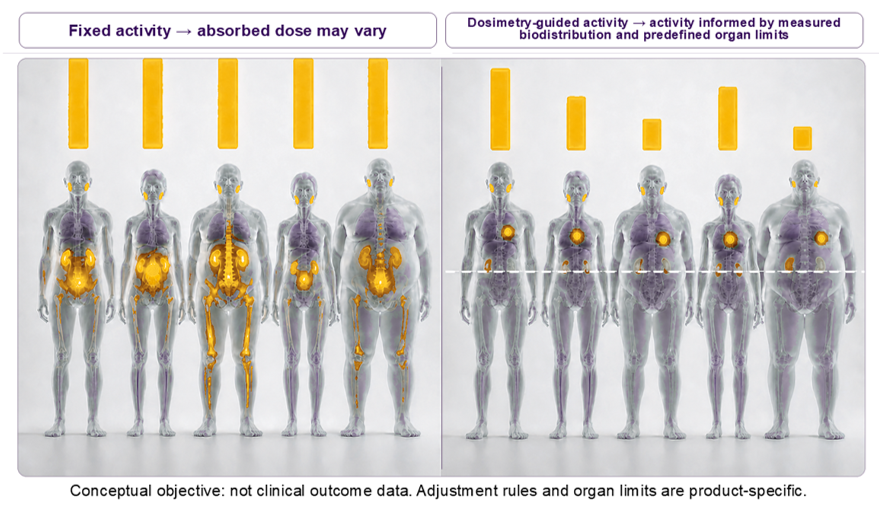
Fixed administered-activity regimens are used in approved RPTs because they are reproducible and easier to implement across sites. That operational advantage is real. It does not eliminate interpatient variability in tumor and normal-organ absorbed dose.
Dosimetry-guided activity adjustment aims to use measured biodistribution and absorbed-dose estimates to inform later administrations. In principle, it may reduce underexposure in some patients and excessive normal-organ exposure in others. In practice, it adds imaging, analysis, scheduling, and validation requirements, and robust product-specific absorbed dose-response relationships are not available in every setting.
Fixed versus dosimetry-guided activity: A conceptual development comparison
A pragmatic development sequence is to:
- Characterize biodistribution and dosimetry early.
- Standardize acquisition and analysis across sites.
- Explore relationships among administered activity, absorbed dose, safety, and activity.
- Prespecify how dosimetry will inform escalation, cumulative limits, or later-cycle adjustment.
- Test any adaptive strategy prospectively before treating it as a clinical benefit.
A 2025 European perspective argued for routine post-therapy absorbed-dose verification as an intermediate step before widespread adaptive dosing. This is an expert position, not a universal regulatory requirement.
What FDA’s Draft Guidance Changes for Radiopharmaceutical Dosage Optimization
FDA’s August 2025 draft guidance, Oncology Therapeutic Radiopharmaceuticals: Dosage Optimization During Clinical Development , remains a draft and contains nonbinding recommendations as of August 30, 2026.
The guidance makes several points relevant to development teams:
- Differences in dose rate and radiation distribution lessen the applicability of external-beam-radiotherapy organ absorbed-dose limits to RPTs.
- The optimized dosage may be higher or lower than one based on external-beam organ tolerances.
- A standard DLT window may not characterize persistent, delayed, or cumulative toxicity.
- If multiple cycles are intended, one-cycle safety data are not sufficient to support the dosage for later development.
- Dosage selection should use the totality of safety, activity, pharmacokinetic or pharmacodynamic, patient-reported outcome, organ-tolerance, and dosimetry data—not the MTD alone.
- Sponsors should generally compare multiple dosages, and randomized dose-response trials may be important.
- Protocols should prespecify limits on cumulative administered activity and corresponding critical-organ absorbed doses.
- Phase 1 studies of radioactive drugs must obtain sufficient data for dosimetry calculations under 21 CFR 312.23(a)(10)(ii).
- Late radiation adverse events of special interest should be monitored for at least 5 years after the last dose, or until death when life expectancy is shorter.
The European Medicines Agency has published a concept paper on clinical evaluation of therapeutic radiopharmaceuticals in oncology. Consultation closed in January 2025; it should not be described as a finalized therapeutic-radiopharmaceutical guideline.
Implications for Early Phase Radiopharmaceutical Trial Design
Evaluate more than one activity and schedule
Small rule-based designs can be difficult to interpret when activity per cycle, interval, cycle number, cumulative exposure, and absorbed dose all matter. Model-based designs can support escalation and overdose control, but they do not replace clinical judgment or the need for longer follow-up.
FDA’s draft guidance also encourages evaluation of multiple dosages and, where appropriate, randomized dose-response comparisons.
Do not treat the DLT window as the full safety horizon
The investigational Phase 1 AcTION study used a Bayesian logistic-regression model across administered activities of 4, 6, 8, and 10 MBq of ²²⁵Ac-PSMA-617. DLTs were assessed during the first 6 weeks. ASCO abstract 5010 included all 101 treated patients as of the November 13, 2025 data cutoff. No DLT occurred and an MTD was not reached; 10 MBq every 8 weeks for up to 6 cycles was selected as the recommended Phase 2 dosage. Dry mouth occurred in more than 90% of patients, was grade 1 or 2, and was mostly unresolved at data cutoff.
This data is preliminary and relate to an investigational product. They do not establish long-term safety, comparative benefit, or an approved dosage. They do show why an initial DLT window and a multicycle safety assessment answer different questions.
Plan cumulative-toxicity monitoring before enrollment
Medical monitoring should define between-cycle laboratory criteria, dose holds and reductions, cumulative exposure review, organ-function monitoring, and follow-up for late radiation effects. Product-specific risks may include myelosuppression, renal toxicity, salivary toxicity, embryo-fetal toxicity, infertility, and secondary myeloid malignancies. The protocol, investigator brochure, informed consent form, safety-management plan, and data-review process should use consistent definitions and action thresholds.
How to Evaluate New Radiopharmaceutical Targets and Combinations
Target expression alone is not enough. A credible target strategy should address:
- Tumor-to-normal tissue separation in human imaging
- Intrapatient and interlesion heterogeneity
- Internalization and retention where relevant to the construct
- Vulnerable normal-organ uptake
- Isotope range, half-life, decay chain, and compatibility with ligand kinetics
- Ability to identify eligible patients with a reproducible imaging or biomarker method
- Manufacturability, isotope access, site fit, and a plausible registrational path
Combination development requires the same discipline. A mechanistic rationale should be paired with an explicit plan for overlapping marrow, renal, hepatic, or other organ toxicity. Approved combinations should be distinguished from investigational ones, and clinical trial results should not be generalized across different ligands or isotopes.
Integrating the Radiopharmaceutical Development Plan
Radiopharmaceutical programs require coordination across multiple teams involved in clinical strategy, medical monitoring, dosimetry, imaging, clinical pharmacology, isotope logistics, site feasibility, CMC, biostatistics, and regulatory affairs. Decisions made in one workstream quickly affect the others: an imaging schedule changes site capacity; a source change can raise comparability questions; a cumulative-activity rule changes enrollment and treatment completion; and a dosimetry objective changes both protocol burden and data architecture.
Allucent provides oncology clinical development support, including clinical pharmacology, medical monitoring, site feasibility, biostatistics, pharmacovigilance, and regulatory and CMC strategy. For radiopharmaceutical programs, the practical goal is to test scientific, operational, and regulatory assumptions together before they become protocol constraints.
Conclusion
Radiopharmaceutical development starts with a fundamental distinction: administered activity is not the same as absorbed dose. From there, the implications spread across isotope choice, imaging, dosimetry, trial design, safety follow-up, manufacturing, and site execution.
The strongest programs will not treat these as separate technical workstreams. They will connect the activity in the vial to the radiation delivered in tissue.
Key Takeaways
- Administered activity and absorbed dose are related, but they are not interchangeable.
- Radiopharmaceutical therapy is the broad modality; radioligand therapy is a targeted subset and should not be used as a synonym in every context.
- Beta- and alpha-emitting products have different ranges, linear energy transfer, dosimetry challenges, and evidence bases. Alpha emitters are not uniformly early-stage: radium-223 is approved, whereas ligand-directed actinium-225 products remain investigational in the United States.
- Randomized Phase 3 evidence supports lutetium-177 therapies in several settings. Approval status must still be stated product by product and indication by indication.
- FDA’s August 2025 radiopharmaceutical dosage-optimization guidance remains a draft as of August 30, 2026. It emphasizes cumulative toxicity, evaluation of multiple dosages, longer follow-up, and early dosimetry.
- Isotope supply, radiochemistry and release, site capacity, and executable multicenter dosimetry can determine whether a scientifically credible program is operationally viable.
FAQs
Request a Proposal
Share This