Contact Us
Industry Featured Articles

Next-Generation Immunotherapy for Solid Tumors: Breaking Through Resistance with Engineered Immune Therapies

Immunotherapy for Solid Tumors

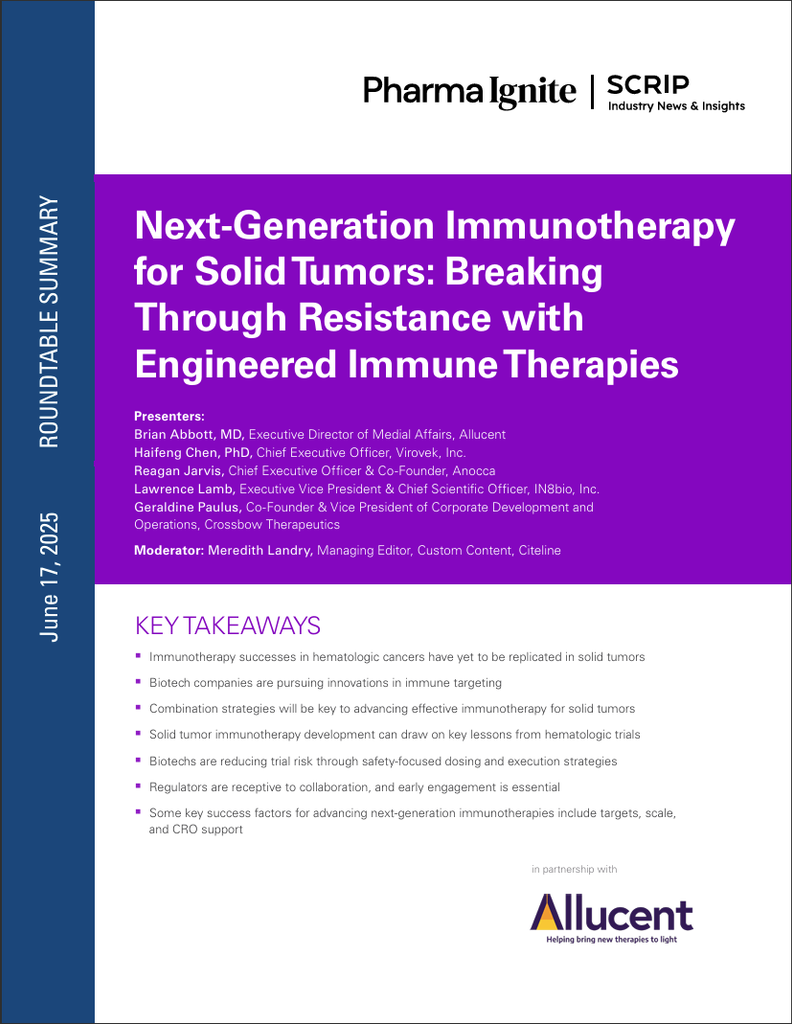
Hosted by Citeline, this expert roundtable convened leaders from pioneering biotech companies and a global CRO to examine the challenges, opportunities, and future direction of next-generation engineered immune therapies for solid tumors. The discussion explored how emerging approaches are building on the success of immunotherapy in hematologic cancers while addressing the unique biological and clinical barriers that have limited similar breakthroughs in solid tumors. 

This report brings together insights from scientific leaders advancing innovative modalities such as TCR-T therapies, gamma delta T-cell platforms, TCR-mimetic bispecific antibodies, and other targeted immune engagers. While engineered immune therapies have transformed outcomes for certain blood cancers, solid tumors continue to present significant challenges, including complex tumor microenvironments, antigen heterogeneity, and safety concerns. The panelists discuss how novel targeting approaches and combination strategies are being developed to overcome these obstacles and unlock more durable clinical responses.  

The conversation also examines lessons learned from successful hematologic oncology trials, including the importance of precise patient selection, focused trial design, quantitative dose modeling, and proactive risk mitigation strategies. In addition, participants share perspectives on regulatory engagement, manufacturing scalability, and the role of experienced development partners in accelerating innovation and reducing execution risk. 

Together, these insights provide a forward-looking view of how next-generation immunotherapies could reshape the treatment landscape for solid tumors. By combining scientific innovation with smarter clinical development strategies, researchers and developers are creating new opportunities to improve outcomes and bring more effective, durable therapies to patients with difficult-to-treat cancers. 

About The Expert Panelists

Brian Abbott, MD, Executive Director of Medial Affairs, Allucent

Dr. Brian Abbott is a medical professional with over 25 years of experience in hematology oncology, including thirteen years in the biomedical research industry. As the Executive Medical Director and Therapeutic Area Medical Lead for Oncology at Allucent, Dr. Abbott oversees clinical trial strategies and medical monitoring for hematology/oncology trials and leads the global oncology medical team at Allucent. His career includes senior medical leadership roles at Myriad Genetics, Caris Life Sciences, and Color Genomics.  

Prior to his industry roles, he spent a decade in clinical practice as faculty at three NCCN member institutions, focusing on leukemia, lymphoma, and bone marrow transplantation (BMT), while serving as a principal investigator in numerous oncology studies. Dr. Abbott’s expertise spans CAR T studies in prostate and hepatocellular cancers, TKIs across various indications, bi-specific antibodies, cytotoxic chemotherapy, and vaccine/cellular therapies. He has significant experience with companion diagnostics registration and phase 1 clinical trials.  

Dr. Abbott earned his M.D. from the University of Tennessee, an MBA from the University of Colorado, and a master’s degree in finance from the University of Wisconsin. He is board-certified in Hematology/ Oncology, Pediatrics, and Hospice/Palliative Medicine 

Haifeng Chen, PhD, Chief Executive Officer, Virovek

Dr. Haifeng Chen is a globally recognized pioneer in gene therapy, with over three decades of transformative contributions to adeno-associated virus (AAV) technology and biopharmaceutical innovation. He earned his B.S. in Biology from Sun Yat-sen University (1982), M.S. in Biology from Sichuan University (1985), and Ph.D. from the University of Saarland, Germany (1992). In 1992, he received the prestigious Marion-Merrell-Dow Post Doctoral Fellowship, conducting groundbreaking research at the University of Kansas Medical Center.  

Chen’s distinguished career includes leadership roles at leading gene therapy companies, including Cell Genesys, Genovo, Avigen, and Asklepios BioPharmaceutical. In 2006, he co-founded Virovek, serving as Chief Executive Officer until 2019. There, he invented the revolutionary “BAC-to-AAV” system, utilizing baculovirus and Sf9 cells to achieve 10–100x higher AAV yields than traditional plasmid transfection methods, setting a new standard for scalable, high-potency AAV production.  

In 2019, Chen co-founded Avirmax, Inc., where he served as Chief Technology Officer and Chief Operating Officer until 2022. Returning to Virovek in August 2022 as Chief Scientific Officer and Vice President, he continues to drive cutting-edge advancements. In 2024, he developed the innovative PACE (Precision AAV Capsid Engineering) technology, enabling precise AAV capsid modifications to target specific cell types based on surface markers. This breakthrough has propelled Virovek to the forefront of in vivo CAR T therapy and solid tumor immunotherapy, with its AAV-based in vivo CAR T therapy yielding successful preclinical data and advancing toward an IND filing by the end of 2025.  

A respected figure in the scientific community, Chen has served on the Viral Gene Transfer Vector Committee of the American Society of Gene and Cell Therapy (ASGCT) and the editorial board of Molecular Therapy – Methods and Clinical Development. His visionary leadership and relentless pursuit of innovation continue to shape the future of gene and cell therapy, addressing critical unmet medical needs with transformative solutions 

Reagan Jarvis, Chief Executive Officer & Co-Founder, Anocca

Reagan Jarvis is the co-founder and CEO of Anocca, a T-cell immunotherapy company based out of Sweden, commencing FIH clinical trials in 2025 with TCR-T cell therapy products in oncology. A New Zealander, Jarvis obtained his PhD in Biochemistry at University of Otago and performed postdoctoral research at the University of Otago and thereafter the German Cancer Research Center (DKFZ) in Heidelberg. He founded Anocca with Mikael Blomqvist in 2014.  

Anocca currently has a pipeline of 40 products. It has 120+ staff, with 36 nationalities and operates the largest cGMP cell therapy manufacturing site in the Nordics. 

Lawrence Lamb, Executive Vice President & Chief Scientific Officer, IN8bio, Inc

Dr. Lawrence Lamb leads scientific and translational strategy as scientific co-founder, Executive Vice President, and Chief Scientific Officer of IN8Bio. While originally extending his NP clinical training in cardiovascular disease as a PhD student, he switched gears and studied immunology, finishing his PhD with a concentration in inflammatory lung disease and macrophage biology followed by postdoctoral training in molecular evolution and genetic engineering of mouse embryonic stem cells to define gene function. During a second postdoc in transplantation immunology at the South Carolina Cancer Center he was the first to describe the association between relapse-free survival and homeostatic γδT cell recovery in high-risk leukemia patients.  

While continuing this work as an Associate Professor and later Professor of Medicine at the University of Alabama at Birmingham, Lamb developed the scientific support for chemotherapy resistant γδT cell-based immunotherapy for high grade brain tumors. This work eventually culminated in successful IND applications that lead to the formation of IN8Bio. Over the course of his career, Lamb’s work has been funded by adiverse array of government and the NCI, NHLBI, NCRR, NINDS, the Children’s Oncology Group, the Elsa Pardee Foundation, the Leukemia and Lymphoma Society, and the National Brain Tumor Foundation including the Samuel Gerson Leadership Chair for Glioblastoma Research 


Geraldine Paulus, Co-Founder & Vice President of Corporate Development and Operations, Crossbow Therapeutics

Geraldine Paulus co-founded Crossbow Therapeutics in October 2021, while a member of the investment team at MPM Capital (now MPM BioImpact),and has served as Crossbow’s Vice President of Corporate Development and Operations since July 2022. Paulus brings a decade of cross-disciplinary and translational academic experience and spent four years in Venture Capital (The Engine, MPM BioImpact), where she focused on due diligence, business development, and company creation. Paulus holds B.S. and M.S. degrees in Chemical Engineering from the KU Leuven (Belgium), a Ph.D. in Chemical Engineering from the Massachusetts Institute of Technology (MIT) and was a postdoctoral fellow in Dr. Ramnik Xavier’s lab at Mass General Hospital (MGH) and The Broad Institute. 

FAQs

Next-generation engineered immune therapies for solid tumors use modified immune cells or engineered molecules to help the immune system recognize and attack cancer cells. Examples include CAR T-cell therapies, TCR-engineered T-cell (TCR-T) therapies, engineered gamma delta T-cell therapies, and targeted immune engagers such as TCR-mimetic bispecific antibodies. These approaches are designed to overcome barriers that have limited the effectiveness of immune therapies in solid tumors, including the tumor microenvironment, antigen heterogeneity, and risk of damage to healthy tissue.
Engineered immune therapies face several interconnected barriers in solid tumors. Antigen heterogeneity means that target antigens may vary across tumor cells, allowing some cancer cells to escape treatment. Physical barriers can prevent immune cells from reaching and penetrating tumors, while the immunosuppressive tumor microenvironment can weaken their activity and persistence. Identifying targets that distinguish cancer cells from healthy tissue is another challenge, because some tumor antigens are also present on healthy cells, creating a risk that treatment could damage healthy tissue. Together, these barriers make it difficult to achieve durable tumor responses while maintaining an acceptable safety profile.
Next-generation engineered immune therapies are being designed to address several barriers in solid tumors. To address antigen heterogeneity, researchers are developing approaches that target multiple antigens, reducing the opportunity for cancer cells to escape treatment. To overcome physical barriers within the tumor microenvironment (TME) that limit tumor access, immune cells are being engineered to reach and penetrate tumors more effectively. To counter immunosuppressive signals within the TME, researchers are modifying immune cells to withstand those suppressive signals and sustain their cancer-killing activity. More selective targeting strategies are also being developed to distinguish cancer cells from healthy tissue and reduce the risk of damage to healthy organs.
Careful patient selection helps ensure that a solid tumor immunotherapy is evaluated in patients whose cancers have the biological characteristics needed for the treatment to work, such as the tumor antigen the therapy is designed to target. In contract, including patients whose cancers lack these characteristics can dilute the observed treatment effect and make a potentially effective therapy appear less active. Well-defined patient populations help sponsors interpret efficacy results and identify which patients may benefit.
Sponsors should engage regulators early in development, before initiating clinical trials, while there is still an opportunity to incorporate feedback into the program. Early, substantive dialogue can help clarify expectations for trial design, patient selection, dosing, safety monitoring, and endpoints. It can also help sponsors assess whether expedited regulatory pathways may be appropriate. Together, these discussions can help sponsors identify and address potential development issues before they lead to delays or rework.
An experienced oncology CRO with integrated scientific, regulatory, and operational expertise can help sponsors align development strategy with clinical trial execution and regulatory requirements for engineered immune therapies in solid tumors. Experience across multiple immunotherapy programs also helps teams anticipate trial design and operational needs, including patient selection, site readiness, dosing, and safety monitoring . By bringing these perspectives together from early development planning through trial execution and regulatory submissions, an experienced oncology CRO can help sponsors make informed decisions, address risks early, and reduce avoidable delays.

Request a Proposal

Additional Resources

Partner With the A-Team

Let us know how we can help you bring new therapies to light. Get in touch to get started.

Join the A-Team

Want to help small and mid-size biopharma companies change the therapeutic landscape?